
When we founded Canonical in 2022, we had a simple but ambitious mission: to back technical founders building the core infrastructure for open, decentralized networks.
Having spent decades as an operator in Silicon Valley, I didn’t want to build a fund that just ‘wrote checks.’ I wanted a vehicle that operated with the same urgency as a startup. We got our wish: we launched straight into a buzzsaw. Between the FTX collapse and a bear market, the ‘easy’ days of venture were over before we even started. But while others pulled back, we leaned in, sharpening our thesis in what was spiking with the founders: the intersection of AI and crypto.
Proof of Work
The only metric that ultimately matters is what makes it back to our LPs.
In a market where many funds are still waiting for “exit windows” to reopen, we’ve stayed disciplined. We have distributed $6.2M in capital to our LPs. We are not interested in maximizing paper TVPI or holding positions to preserve optics. Our goal is to prove that the Canonical approach to frontier investing generates real liquidity, early. Fund I is currently performing in the top tier of its vintage, moving through the early part of the J-curve faster than expected.
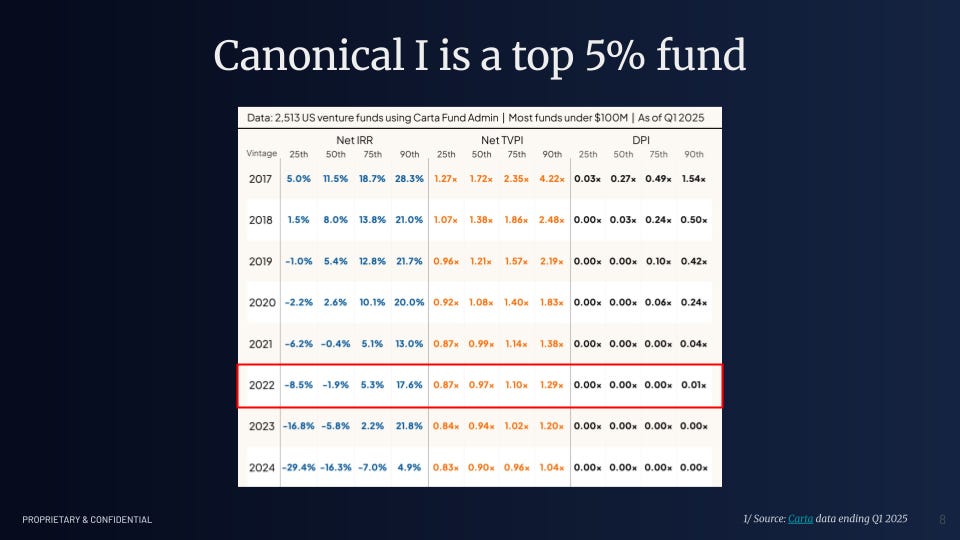
We are actively investing and continuing to focus on what we believe is the highest-leverage stage: -1 to 0 in open-source frontier networks.
Our Investment Philosophy: -1 to 0
We spent 2025 doubling down on finding exceptionally talented people before they have even fully formed a company. We are not looking for trend-followers. We care far more about the people than the pitch. Our recent investments highlight this: Kocree (Small models), Fractal (World models), Stealth Co (Data), and Stealth Incubation (Robotics).
Anti-Defaults & The AI Paradox
We have become increasingly skeptical of “default thinking” in AI. Specifically the idea that simply building bigger neural networks is the only path forward.
We are not “anti-AI,” but we are anti-default. Some of the most interesting work we’re seeing right now challenges today’s architectural assumptions entirely. This means different learning paradigms, different system designs, and more first-principles thinking. We want to find the founders who are honest about where current approaches break down.
There is a massive risk that isn’t being discussed enough: the extreme centralization of intelligence. If a handful of companies control the models, the data, the algorithms and the compute, they control the future. That is a scary prospect. Our focus remains on open source and frontier approaches that sit outside the gravity well of today’s incumbents.
What We Saw in Asia
This concern about centralization became even more real during our recent trip to Asia. It’s clear that while the West is currently winning on software “brains,” the “bodies” (robotics) and the open manufacturing protocols are being defined elsewhere.
The speed at which they are iterating on open-source hardware in China is staggering. It is a sobering reminder that frontier tech is truly global. We need to pay attention—not just to the software, but to the physical machines being built at scale.
This rise of global, open-source robotics creates a massive problem: How do you coordinate and verify these machines at scale without a central authority? This is where our conviction in blockchains remains unshaken.
The Reality of 2025: Crypto is Dead (Again)
2025 reminded us that this path isn’t a straight line. The “October Shock”, which saw many crypto assets crash, cleared leverage and reset pricing. But we don’t see this as a failure; this flushes out the noise and resets the market.
It has become a ritual to declare crypto dead. AI is the new obsession and it’s pulling talent. We have seen some of that shift inside our own portfolio. We think it’s a pendulum, not a one-way door.
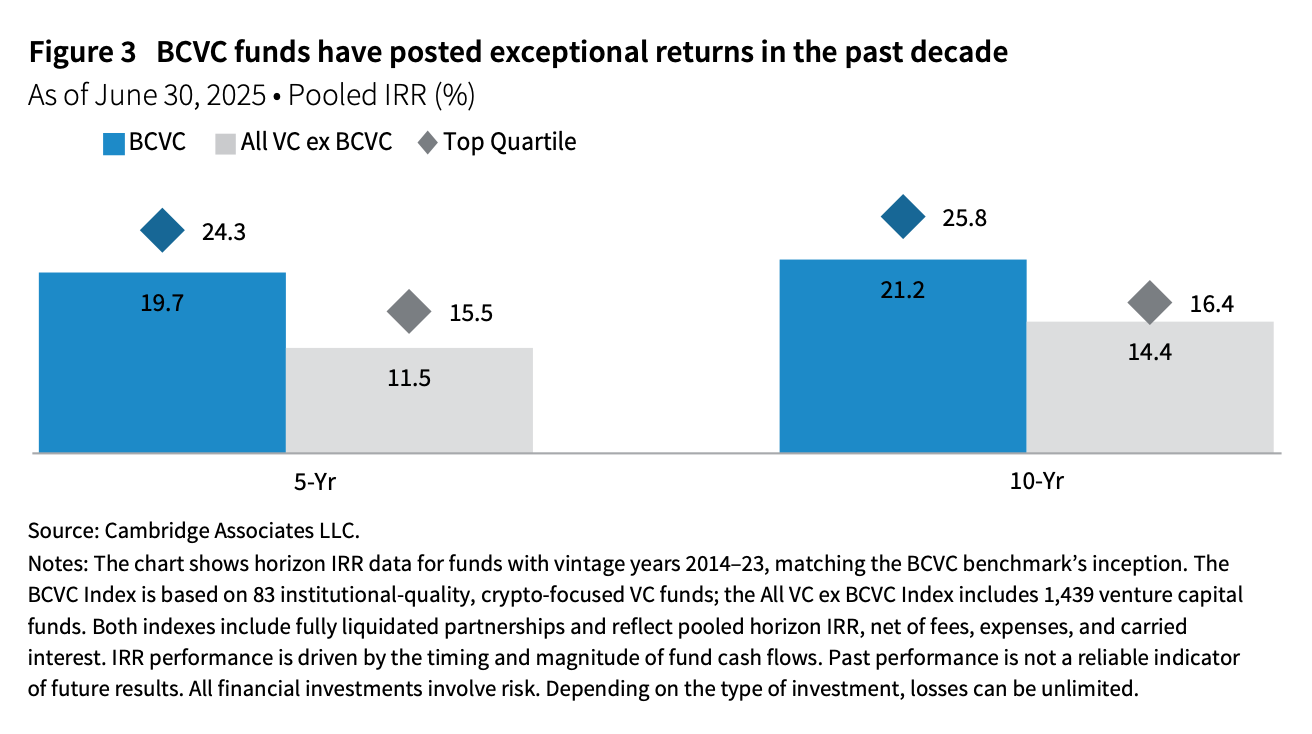
Crypto is a resilient asset class, and it continues to remain an exciting venture prospect. According to Cambridge Associates, Blockchain and Crypto-focused venture capital (“BCVC”) delivered a 10-year pooled net IRR of 25.8%, compared to 16.4% for the rest of the VC universe.
We have attended several funerals for this industry already. Every single time, it has walked out of the grave stronger than it went in. We are happy to stay contrarian, let the hype settle, and continue following the returns.
Looking Ahead
We have hit a turning point. Blockchains have finally reached a level of scaling and maturity where they are “boring”, but in the right way.
We’re seeing more fintech plumbing, especially settlement and treasury via stablecoin rails, move onto blockchains. Finance is still just the first use case.
The alpha is in using blockchains as a coordination and verification layer beyond finance, especially as AI and robotics move from software into the physical world.
Canonical is growing. Anthony (previously co-founder & partner of Seed Club Ventures) joined the team last year, bringing a level of operational expertise and depth that has already changed how we operate. We are still a small, lean operation, and we like it that way.
If 2025 reinforced anything, it’s that we are still in the very early innings. The hype cycles move fast, but the underlying shifts in open source, AI, robotics, and decentralized coordination are generational. We remain incredibly optimistic because the founders we are meeting are more ambitious than ever.
All that said, while the numbers last year were strong, we are not writing this to take a victory lap. In frontier tech, things change too fast for ego. We know the path ahead will have more shocks and speed bumps. There is a massive difference between knowing the path and walking it. We built this fund to “be in the arena”. We are here for the dust and the sweat, and we are just getting started.
Onward to 2026.
The Canonical Team