
Minghui Xu published a paper in February 2026 proposing that blockchains are the natural infrastructure layer for physical AI. We have historically only thought of blockchains as an instrument for finance, but this paper was suggesting giving autonomous machines identity, payments, and coordination.
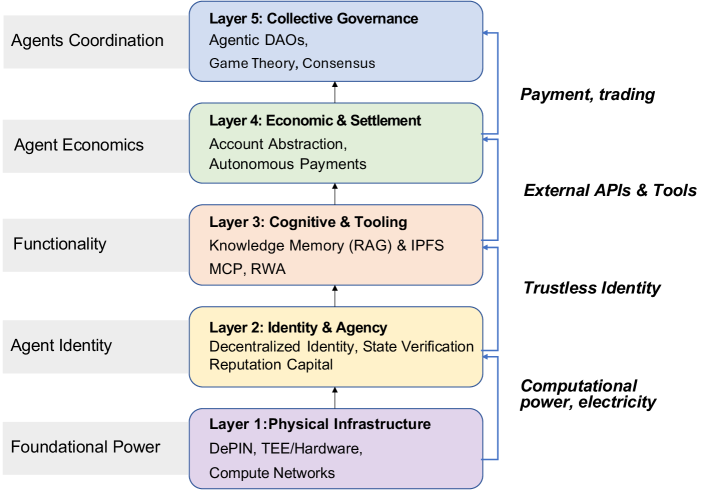
The argument is surprisingly concrete. Current AI agents can’t hold assets, can’t receive payments directly, and have no persistent identity across platforms. Xu proposes a five-layer blockchain stack that solves all three: DePIN for physical infrastructure, W3C DIDs for machine identity, RAG and MCP for cognitive tooling, account abstraction for settlement, and collective governance for coordination. The whole architecture is designed so machines can participate in markets the way humans do.
The idea has an eight-year paper trail. Sentis and Arduengo proposed robots transacting via self-executing smart contracts back in 2018. The AI and the blockchain infrastructure weren’t mature enough, but the core intuition was the same — machines need a way to commit to agreements, verify execution, and settle payment without relying on a legal system or a human intermediary. Rothschild et al. at Microsoft Research arrived at a similar conclusion from the market design side in 2025. The convergence from robotics, market economics, and blockchain research independently is what makes this feel like more than a whitepaper.
And then Virtuals Protocol showed what it actually looks like running. A humanoid 3D-printed a part and requested delivery through their Agent Commerce Protocol. A rover transported it to a shipping point. A drone flew it to final delivery. Each handoff negotiated its own price and settled payment onchain on Base using x402 and USDC. Three robots from three companies completing an autonomous supply chain. No human touched the package or the money.

The reason blockchain keeps showing up in these architectures is practical, not ideological. When three robots from three different companies need to coordinate a transaction, you need identity that persists across platforms, payments that settle without a shared bank account, and a coordination layer that works across organizational boundaries. Centralized APIs can’t do this cleanly. Blockchains can.
The agentic economy is being discussed mostly as a software phenomenon today: agents booking flights, negotiating prices, managing inboxes. But it might arrive through hardware first. Machines that move through physical space, settle their own payments, and coordinate without a human in the loop. That’s the version Xu’s paper describes, and the Virtuals demo just proved it works.
Blockchains might just be the substrate for physical AI.