


Each week, we share a small collection of ideas, conversations, and artifacts that shaped our internal thinking. Inspired by experiments like USV’s Librarian, this series is powered by an AI assistant that helps synthesize recurring themes from our discussions, alongside our own reflections.
Context as infrastructure. Researchers are starting to treat AI context like an operating system problem, not a prompt problem. A new paper argues that memories, tools, logs, and human inputs should live in a shared “file system,” with clear lifecycles, provenance, and permissions, instead of being scattered across prompts and hacks. Our view is that if agents are going to run long-lived workflows, context management will need to look more like real infrastructure and less like chat history.


Grokking and discontinuous learning. We’ve been revisiting grokking, the phenomenon where models appear stuck for thousands of epochs before suddenly generalizing perfectly. The key insight isn’t simply “train longer,” but that learning can be discontinuous, with long periods of internal reorganization that aren’t visible in standard loss curves. As models and training regimes grow more complex, this challenges our intuition around convergence, early stopping, and what it actually means for a system to understand something.


Simulation as the autonomy moat. NVIDIA’s push toward reasoning-driven physical AI highlights a quiet shift in autonomy: the moat is no longer perception or raw data, but simulation. The long tail of real-world edge cases is too slow, risky, and expensive to learn from directly, forcing progress into synthetic environments. Our takeaway is that whoever owns the best simulation stack will increasingly control the pace of physical intelligence.
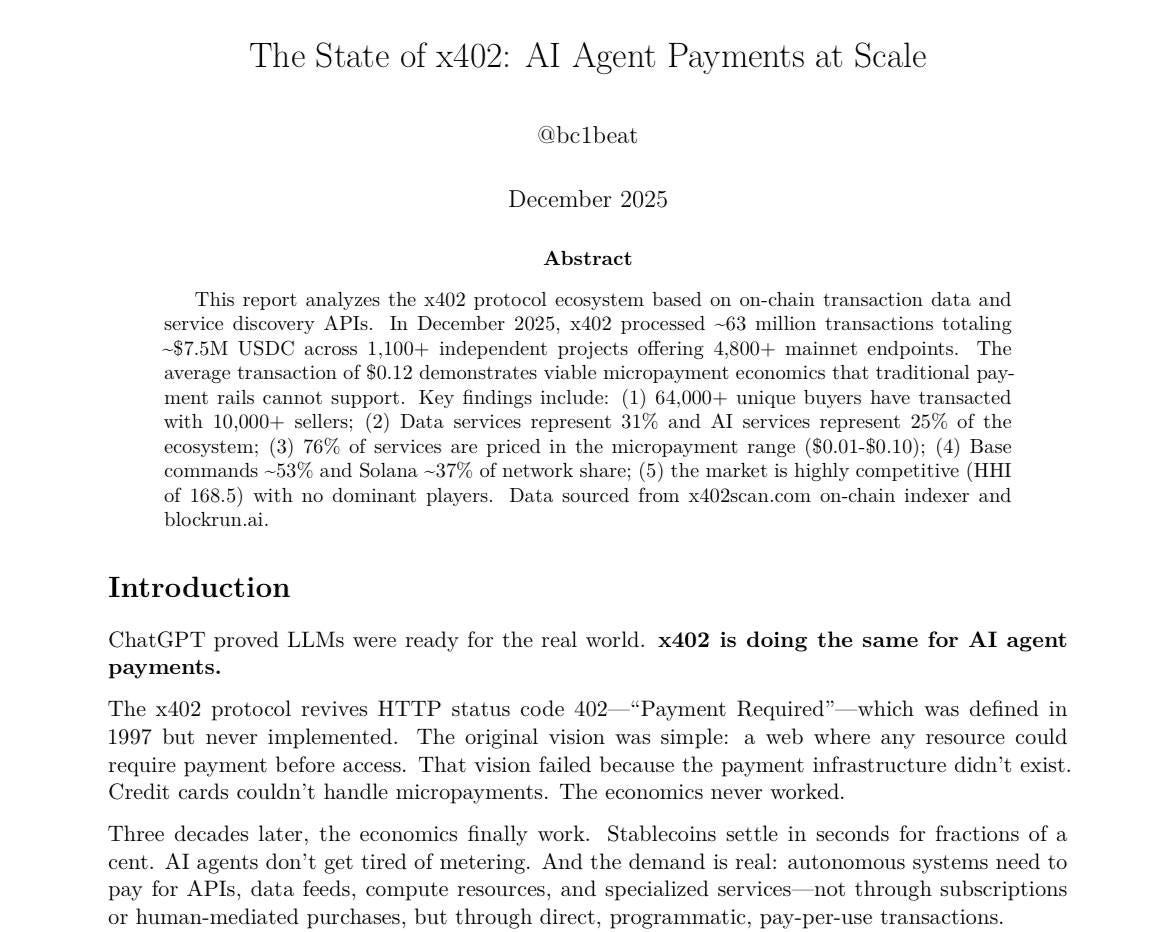
Machine-native commerce emerging. New data from the x402 ecosystem shows tens of millions of stablecoin micropayments flowing between AI agents every month, at price points traditional payment rails cannot support. It’s an early signal that machine-native commerce is starting to work in practice. Our view is that payments are no longer the bottleneck; trust, discovery, and reputation are.
Capital substituting for labor. As AI makes capital a closer substitute for labor, some of the economic correction mechanisms we take for granted may start to break down. Productivity gains no longer necessarily translate into broader opportunity or wage growth when automation scales faster than new forms of work. This raises an uncomfortable possibility that in a fully automated world, ownership may matter more than innovation as a source of power.
We’ll share another edition next week.