

Each week, we share a small collection of ideas, conversations, and artifacts that shaped our internal thinking. Inspired by experiments like USV’s Librarian, this series is powered by an AI assistant that helps synthesize recurring themes from our discussions, alongside our own reflections.
We’ve been exploring different paths to AGI that don’t try to build intelligence from text alone, but instead focus on modeling how intelligence actually works in the brain. The idea is that if you can capture enough data about neural activity and behavior, you can begin to model the underlying structure of thought itself. Whole-brain emulation is one expression of this idea, aiming to simulate cognition directly, and points toward AI systems that are more interpretable, efficient, and grounded in biology than today’s models.
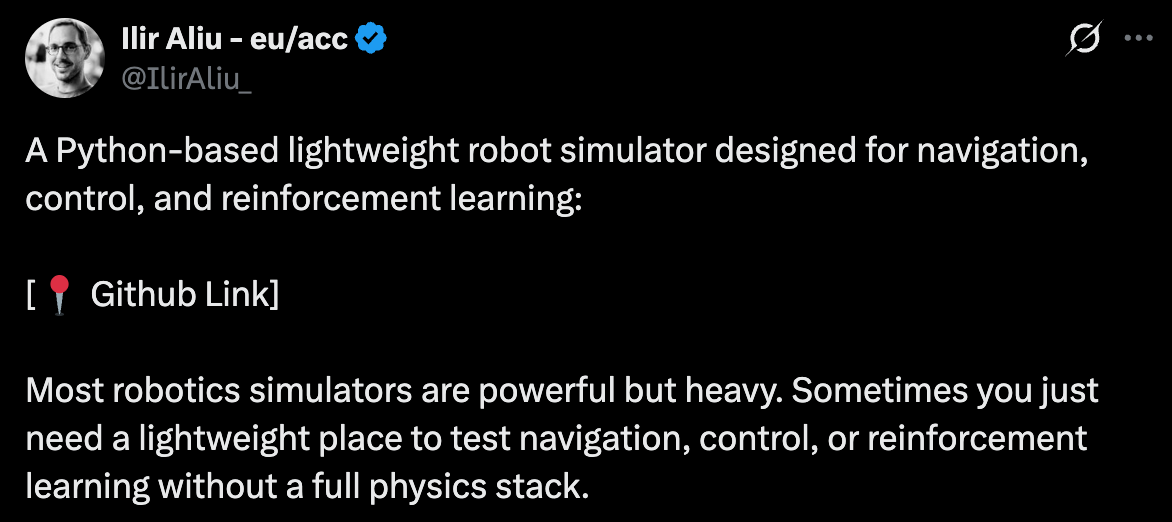
Robotics development is still constrained by the cost and friction of real-world experimentation. Simulation offers a way to move more iteration into software, enabling faster experimentation and safer testing before deployment. A new Python-based, lightweight robot simulator for navigation, control, and RL points toward this kind of workflow, lowering barriers to build and test embodied AI. As robotics moves closer to production, more accessible simulation tools may play an outsized role in accelerating progress.
A talk at SmartCon explored a growing constraint in ML: most valuable data is private, and doesn’t live on the public internet. The idea of “props” uses oracles and confidential computing to securely source private data, verify its authenticity, and use it for training or inference without exposing the raw inputs. What’s compelling is the notion of an end-to-end security perimeter, which, if scaled, could meaningfully expand the usable data frontier for AI while preserving trust.
Boom Supersonic announced a 42 MW natural gas turbine optimized for AI datacenters, repurposing technology originally developed for supersonic flight. In today’s AI paradigm, power rather than compute is increasingly the bottleneck. Using an aviation engine to power AI infrastructure is a striking example of cross-domain innovation. What’s especially interesting is that deploying these engines at scale for AI also generates real-world operating data for Boom, helping accelerate development of the underlying engine.

Can LLMs help VCs? Using a real-world dataset of over 60,000 startups, authors of this paper show that LLM agents can organize and categorize deal flow hundreds of times faster than humans, while achieving comparable or better structure. The takeaway isn’t that AI replaces judgment, but that it dramatically reshapes the earliest stage of the funnel, where volume, noise, and unstructured data dominate. For smaller funds, this could lower barriers to competing on sourcing and screening, turning what was once a headcount problem into a software problem.
We’ll share another edition next week.