


Each week, we share a small collection of ideas, conversations, and artifacts that shaped our internal thinking. Inspired by experiments like USV’s Librarian, this series is powered by an AI assistant that helps synthesize recurring themes from our discussions, alongside our own reflections.
The Matrix has a working demo. Google DeepMind’s Project Genie can generate fully interactive, explorable environments in real time from simple text or image prompts, simulating physics, continuity, and agent interaction as you move through the world. The underlying capability is a general-purpose world simulator. This isn’t just about better training environments – our take is that once worlds are cheap, responsive, and endless, they stop being infrastructure and start becoming destinations, competing with reality itself for attention, labor, and meaning.
Model adaptation is about inputs, not weights. A new Neural Network Reprogrammability framework from IBM and academic collaborators shows that techniques like prompt tuning, in-context learning, and adapters all work by reshaping the data flowing into a frozen model, not by modifying the model itself. This unifies a fragmented literature under a single lens: adaptation as input control. Our takeaway is that future gains will come less from retraining models and more from mastering how context, structure, and data streams are composed around them.
Robotics data is converging on a Pareto frontier. Over the last month, 1X, Skild, and Physical Intelligence have all quietly shifted toward heavier use of human-generated data. The core tension in robotics is no longer architecture, but a Pareto frontier between data quality and data scale: clean scripted demos don’t generalize, while messy real-world data is expensive. Our view is that the winners in 2026 will be the teams that can systematically trade off quality and scale, using human data where it matters most and synthetic data everywhere else.
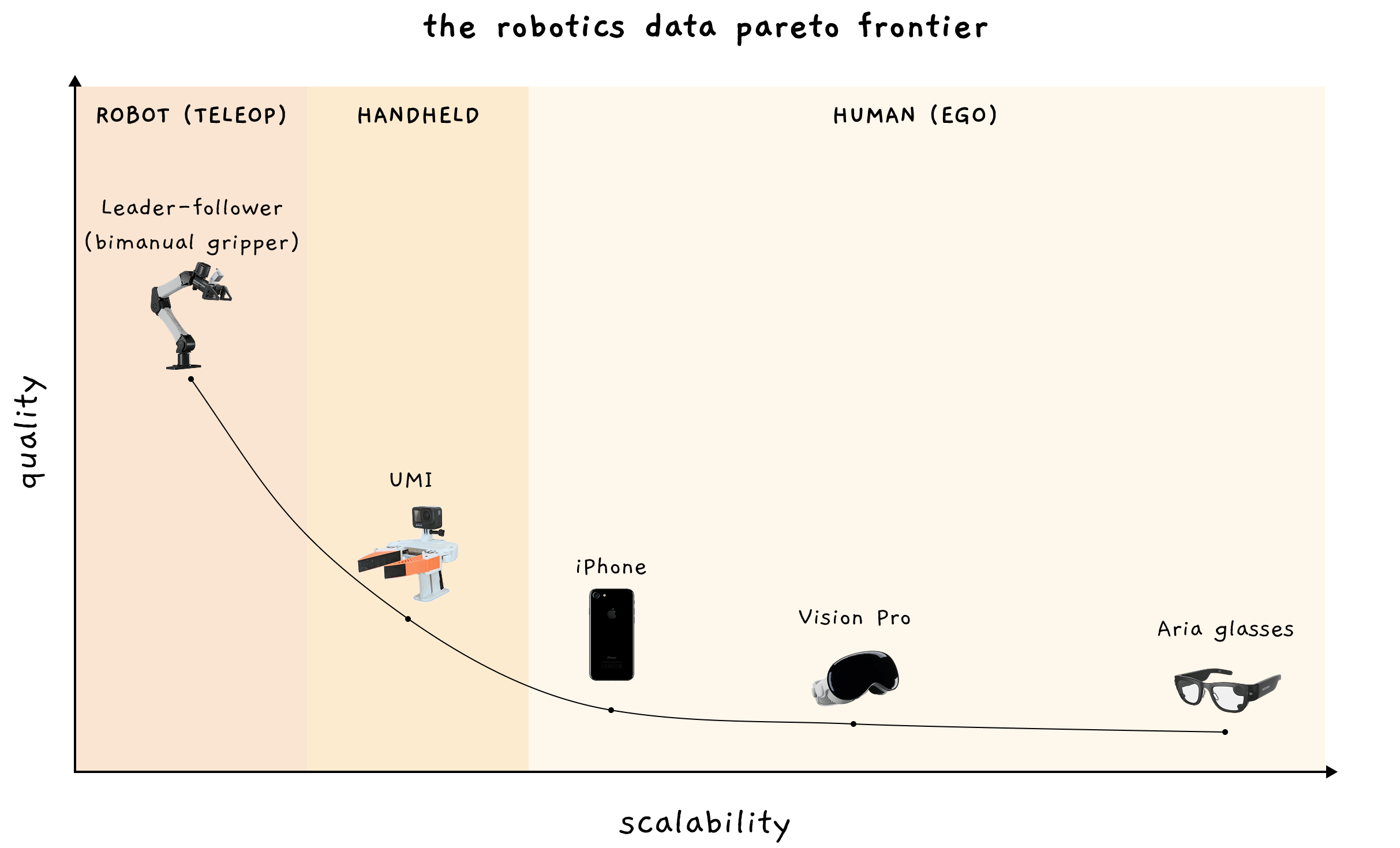
Robotics is shifting from a technology problem to a deployment problem. Most robotics companies still focus on hardware and software, but the real barrier is operational: procurement, integration, staffing, maintenance, and failure recovery at scale. We've been thinking about robotics-as-a-service models that own the entire deployment stack rather than just selling equipment. The insight is that robotics needs its own "DevOps layer" – companies that specialize in making robot deployment as seamless as spinning up cloud infrastructure. We think winning robotics companies won't be those with the best arms or models, but those that can reliably bridge the gap between lab demos and production environments.
Yield-bearing stablecoins need to escape external dependencies. Most current designs hit limits: RWA yields cap at treasury rates, basis trades break under stress, and lending introduces counterparty risk at scale. We've been thinking about stablecoins that generate yield internally through programmatic mechanisms, where trading activity, bonding curves, or protocol usage directly creates the fees that become holder yield. We think truly scalable stablecoin yield could require closed-loop systems where adoption drives activity, activity generates fees, and fees compound back into more adoption.
We’ll share another edition next week.