


Each week, we share a small collection of ideas, conversations, and artifacts that shaped our internal thinking. Inspired by experiments like USV’s Librarian, this series is powered by an AI assistant that helps synthesize recurring themes from our discussions, alongside our own reflections.
There’s been a persistent critique that many AI startups are just thin wrappers around LLMs. That framing breaks down in an agentic world, where real value sits above the model layer in orchestration, domain-specific data, tools, interfaces, and feedback loops. As AI systems are deployed as “digital professionals” inside real workflows, the moat increasingly comes from vertical focus, deep integration, and change management, not just access to a base model.


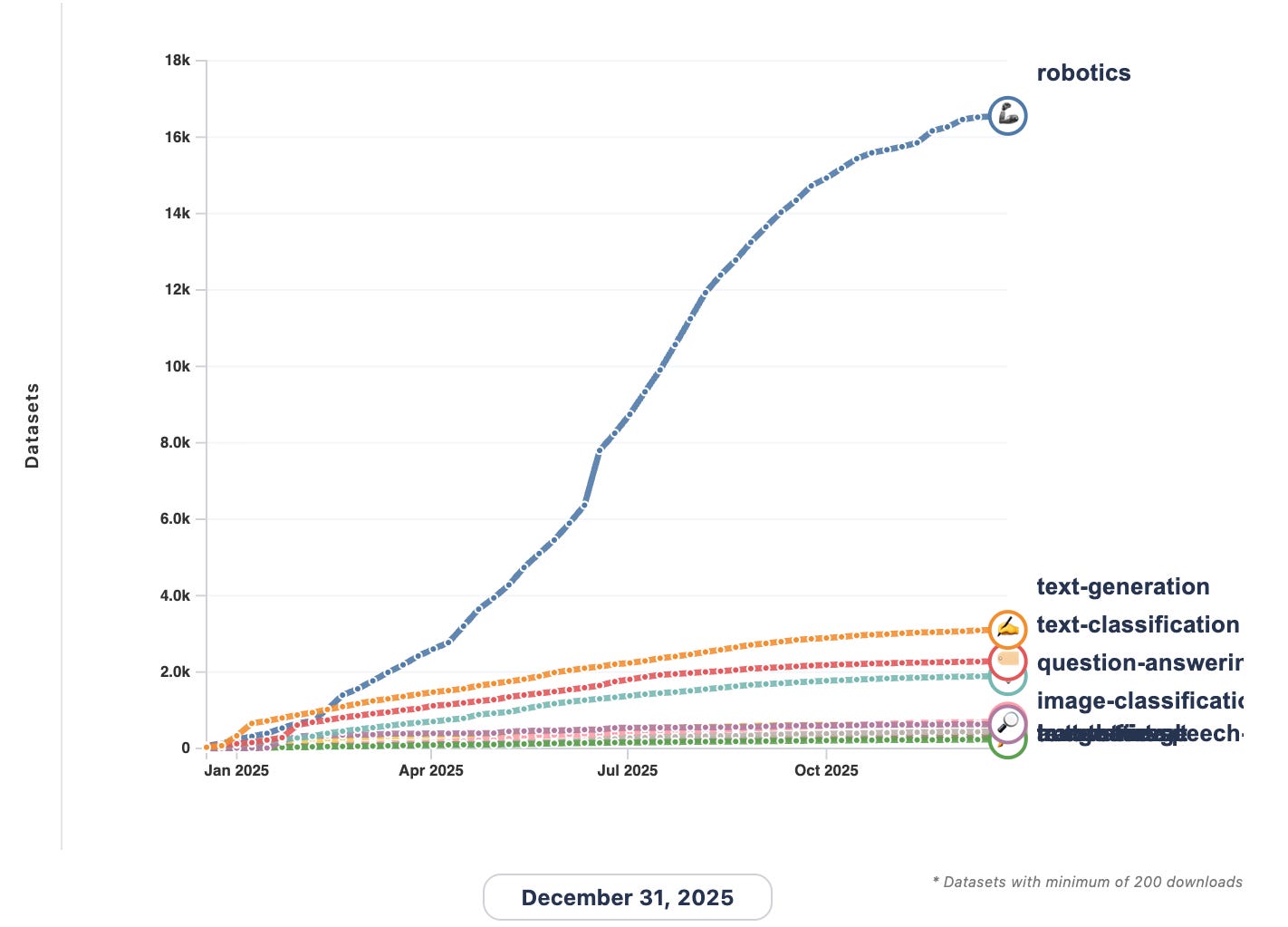
Robotics has quietly become the fastest-growing data category in AI. On Hugging Face, robotics datasets jumped from just over 1,000 in 2024 to nearly 27,000 in 2025, climbing from the bottom of the rankings to the single largest category in only a few years. The shift reflects a broader transition in AI from text-only intelligence toward embodied, multimodal systems, where progress is gated less by model scale and more by access to diverse, real-world interaction data.
Physical Intelligence demonstrated humanoid robots performing everyday tasks like making peanut butter sandwiches, cleaning windows, peeling oranges, and washing greasy pans, inspired by Benjie Holson’s “Robot Olympics.” These deceptively simple challenges highlight Moravec’s Paradox: tasks humans find trivial remain exceptionally hard for machines. The results suggest that progress in robotics depends less on programming and more on large-scale, embodied pretraining, where physical intelligence is learned from data rather than hand-coded.
Simulation lets materials scientists experiment in software before committing to the real world. As machine-learned interatomic potentials have improved, the bottleneck has shifted from models to simulation, which remains largely CPU-bound and misaligned with modern ML workflows. We think NVIDIA’s ALCHEMI Toolkit-Ops reflects a broader shift toward reducing these frictions by bringing core simulation primitives onto the GPU with a PyTorch-native interface, making large-scale, batched simulation more practical.
We’ve been discussing whether anything in quantum actually moves the needle right now, and error correction feels like the only milestone that matters. Recent reporting on neutral-atom systems suggests a credible path from fragile prototypes to verifiable, logical qubits. Our take is that this doesn’t make quantum commercially relevant yet, but it does move from speculative physics toward an engineering problem, one that will likely progress slowly, capital-intensively, and more like infrastructure than software.
We’ll share another edition next week.
Thanks for writing this, it clarifies a lot. Ethical agentic scaling: your thoughts? Brilliant.