
Five ideas, papers, and products shaping our investment thinking, and what we think they mean. This series is powered by an AI assistant that helps synthesize recurring themes from our discussions, alongside our own reflections.
Amazon blocked Meta’s shopping agent, and its rivals rushed to plug in. Meta launched Muse on September 8, a personal agent that shops, books, and pays from its own cloud computer, and it went straight to the top of the App Store. Amazon blocked it, but Walmart, Shopify, PayPal, and Expedia integrated. This matters because an agent never sees a sponsored listing, and Amazon made more than $68 billion from ads last year. We think this is the playbook in every category: incumbents block agents, challengers embrace them to take share, and incumbents come around later on worse terms. Most exposed are the businesses that monetize inertia, like subscriptions nobody cancels and insurance nobody reprices.


BlackRock says agents will pay in stablecoins. The biggest agent launch of the year pays with cards. BlackRock published The Machine-Native Economy this week, arguing that agents need programmable, always-on money and naming stablecoins, Ethereum, and Circle’s Arc as the likely rails. Meanwhile, Muse checks out through Stripe’s Link wallet, using a saved card or a single-use virtual one. This matters because consumer agents inherit the rails of the person they act for, and that person already has a card on file. We think stablecoins win where there’s no human account behind the transaction at all: agents paying APIs, other agents, and compute per call, across borders and in amounts too small for card economics.


950 Claude agents found a new CRISPR-like enzyme system in 21 hours. Anthropic’s new life sciences lab pointed Claude at a DNA database with a single prompt. Roughly 950 agents sorted more than 200,000 enzymes into 20 written reports, and one spotted a repeating DNA pattern beside an unusual enzyme that nobody had described, reminiscent of CRISPR. This matters because genome mining that used to take an expert weeks to months now takes a day of compute, and hypotheses are becoming abundant. We think the bottleneck in science is moving from generating ideas to verifying them, and the durable value sits with whoever owns the validation loop: wet labs, automated experimentation, and the taste to decide what’s worth testing.


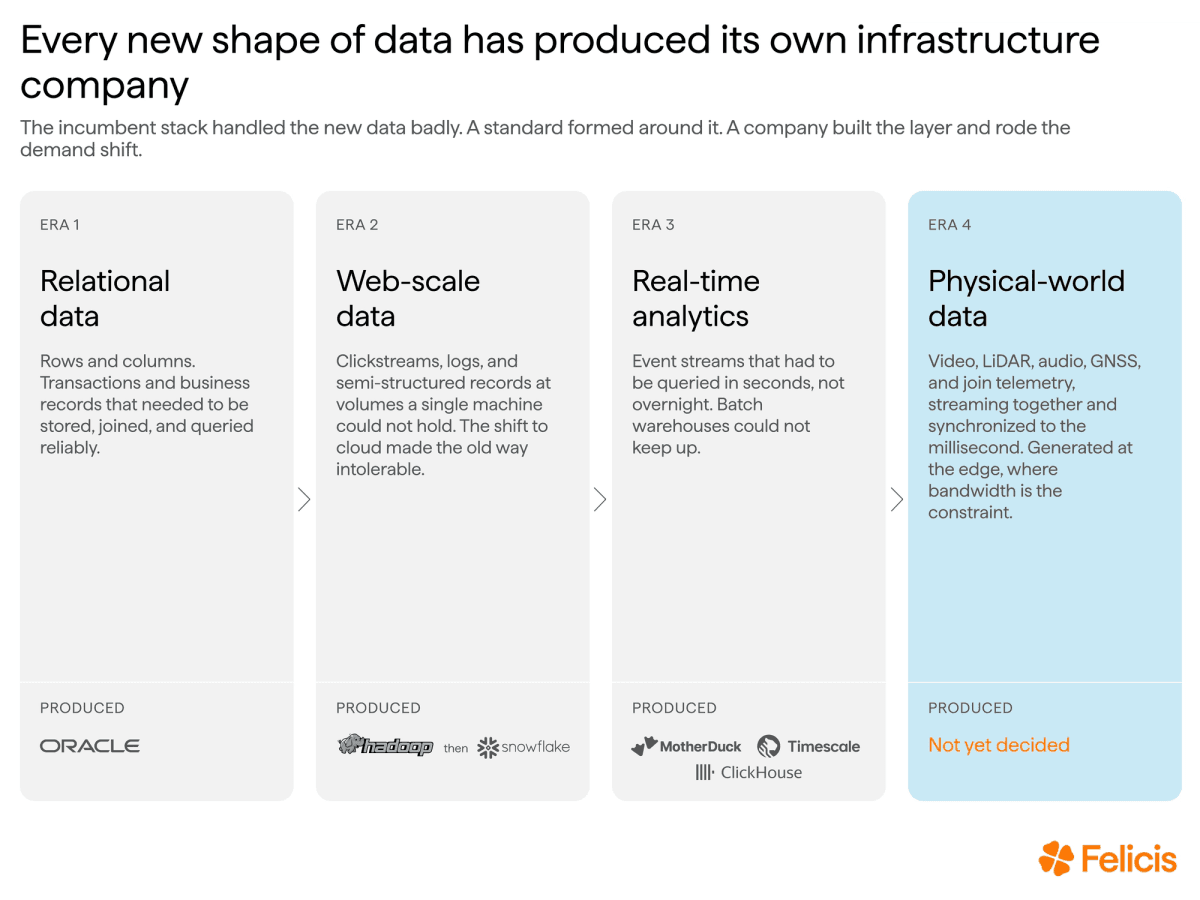
Robots are generating data nobody can store. Felicis argues the physical world has no data stack. A single autonomous vehicle can produce terabytes a day of synchronized video, LiDAR, and telemetry, and most of it gets sampled down or deleted, because today’s tools were built for rows and columns. Foxglove, whose open MCAP format is the default logger in ROS 2, is the early leader. This matters because every fleet that scales becomes a data infrastructure customer, and every robot foundation model needs that data to improve. We think the pre-seed openings are at the edges: deciding on the robot what’s worth keeping, and making physical-world data portable enough to share and sell, because data that can’t move can’t compound.
DeFi built the right tools for the wrong assets. Multicoin’s new essay on DeFi 2.0 argues that order books, fixed-rate lending, and portfolio margin have existed onchain for years, but were built for volatile, perpetual cryptoassets that didn’t need them. Treasuries, equities, and credit have maturities, cash flows, and identifiable borrowers, which is exactly what those primitives were designed for. This matters because the RWA conversation has been stuck on tokenization, when the value is in what happens after an asset arrives. We think the best early bets are primitives whose market grows with the asset base, and fixed-term, underwritten credit for real borrowers is the one we care about most, because it’s what hardware and robotics credit needs to move onchain.
We’ll share another edition next week.