
Open source began as a hedge against concentrated power. Linux, Apache, Python, Kubernetes, RISC-V: foundational software built by people who did not want any single company owning the layer everyone else depends on. It was the closest thing computing had to a commons, and for thirty years it was mostly a Western, hobbyist, faintly libertarian project.
In 2026, the largest sponsor of free frontier AI is the Chinese state.
Start with the facts. The open models that keep landing at or near the frontier are increasingly Chinese. DeepSeek, Qwen, and Moonshot’s Kimi now trade blows with the best American models on real benchmarks, ship under permissive licenses, and arrive within months of the closed frontier. The old story was that China was a cheap fast-follower, a year back at a tenth of the price. That story is out of date. The gap is now measured in months, and the strongest Chinese labs are confident enough to charge close to full price for a hosted version while still giving the weights away.
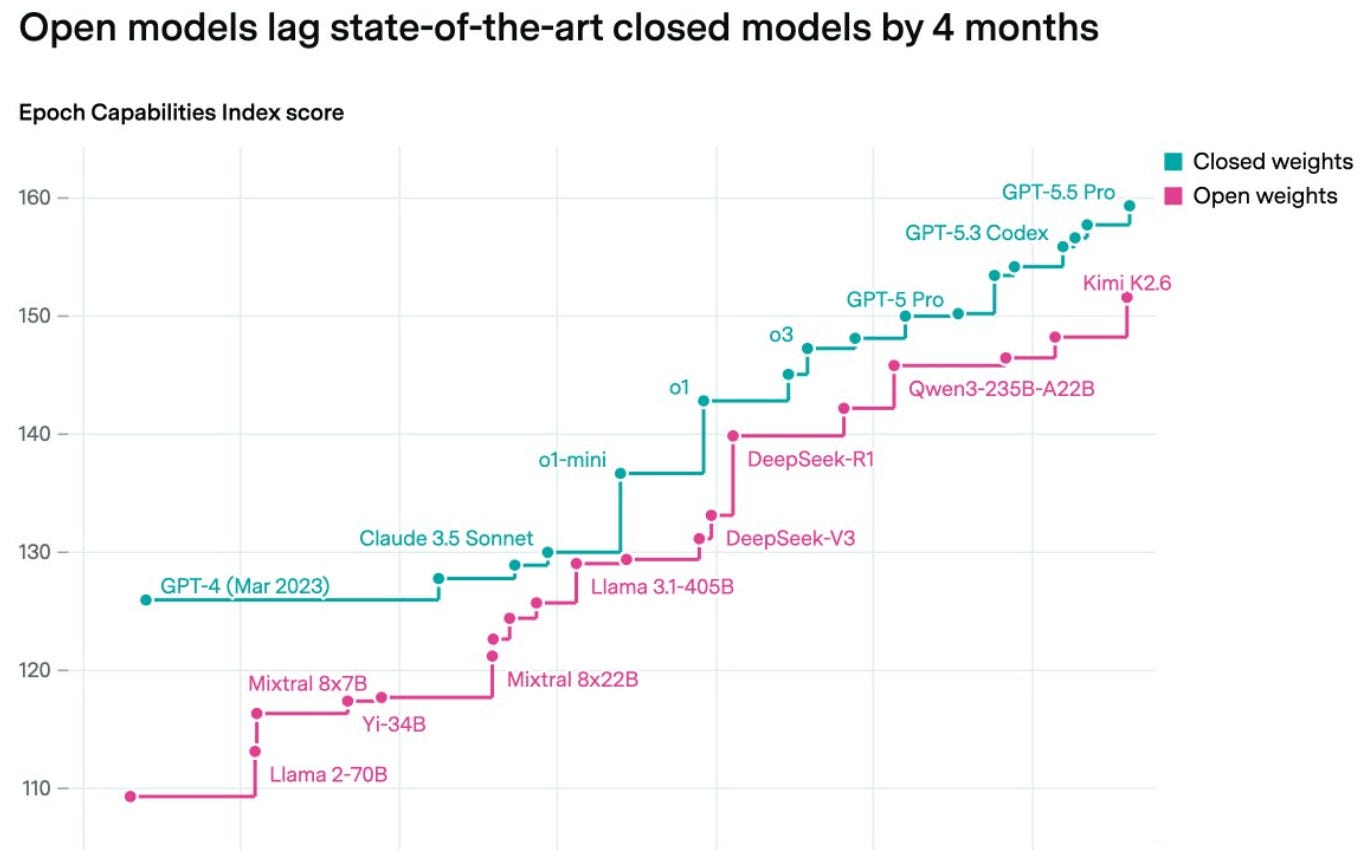
This is deliberate commoditization, sanctioned from the top. If you cannot win the frontier outright, the next best outcome is to make sure the frontier is not worth much. Open weights turn the core asset of OpenAI and Anthropic into a free good. They also set the default. Every developer who builds on a Chinese open model is one more person fluent in China’s tools, standards, and assumptions. The United States understood this logic perfectly when it gave GPS away and let the world build on top of it. Whoever owns the standard owns the leverage that comes with it. China is running that playbook one layer up, at the model.
There is a sharp irony underneath this. Export controls were meant to protect an American compute lead. What they actually did was force Chinese labs to get radically better at doing more with less. Starved of the newest chips, they leaned into efficiency: sparser models that wake only a fraction of their parameters per token, cheaper attention, aggressive compression. The same thing happened in lithography, where a constrained foundry reached advanced nodes on older equipment because it had no other option. Constraint is a forcing function. The controls meant to widen the moat are training the discipline that drains it.
This is the part worth sitting with. Open source was supposed to be insurance against concentrated power. Today the biggest force pushing free frontier intelligence into the world is an authoritarian state. We still believe open beats closed. We wrote that recently and we mean it. What changed is not the direction, it is who benefits.
The United States has no clean answer. Banning Chinese open models mostly binds American firms: weights spread by torrent, so you get costlier domestic AI while the rest of the world standardizes on Chinese models anyway. Winning the open game directly needs a lab both willing to open a frontier model and able to build one, and no American lab is both. Either path cedes the default.
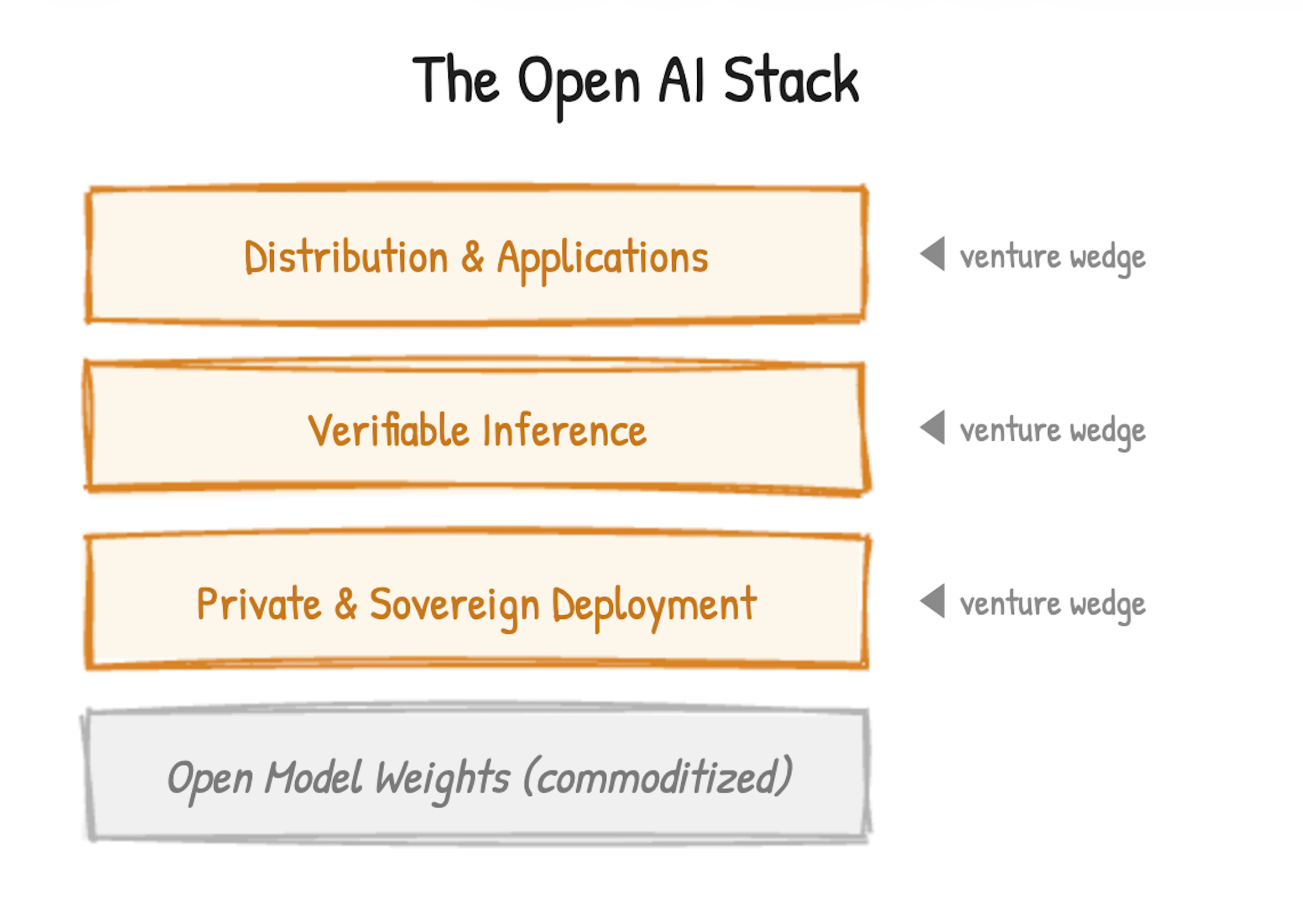
For us, the investing implication follows directly. If the model layer is commoditizing and going open, and it is, then durable value does not sit in the weights. It sits in what open weights cannot commoditize: verifiable inference, private deployment, the sovereign and enterprise builds that cannot run on a foreign API, and the distribution that turns a free model into something people actually pay for. Open winning does not mean nobody captures value. It means value moves, and it moves to exactly the layers we have been backing.
The world’s default intelligence may end up open, cheap, and not American. That is not a prediction we love. It is one we would rather underwrite than ignore.