
Quantum had a big year. Quantinuum raised $1.68B in its IPO. Google published an estimate that breaking the cryptography behind Bitcoin could take fewer than 500,000 qubits, ~20x fewer than prior estimates. Washington agreed to put $2B into quantum companies in exchange for equity. The easy conclusion is that the quantum computer is about to arrive and everything changes.
We spent the past week working through the physics, the machines and the companies, and came out with a different view. “Quantum” is not one market. It is four businesses with different customers and different clocks: computing, sensing, communications, and security. The one everyone talks about, the quantum computer, is the furthest from paying customers. The other three are where we expect the first venture outcomes.
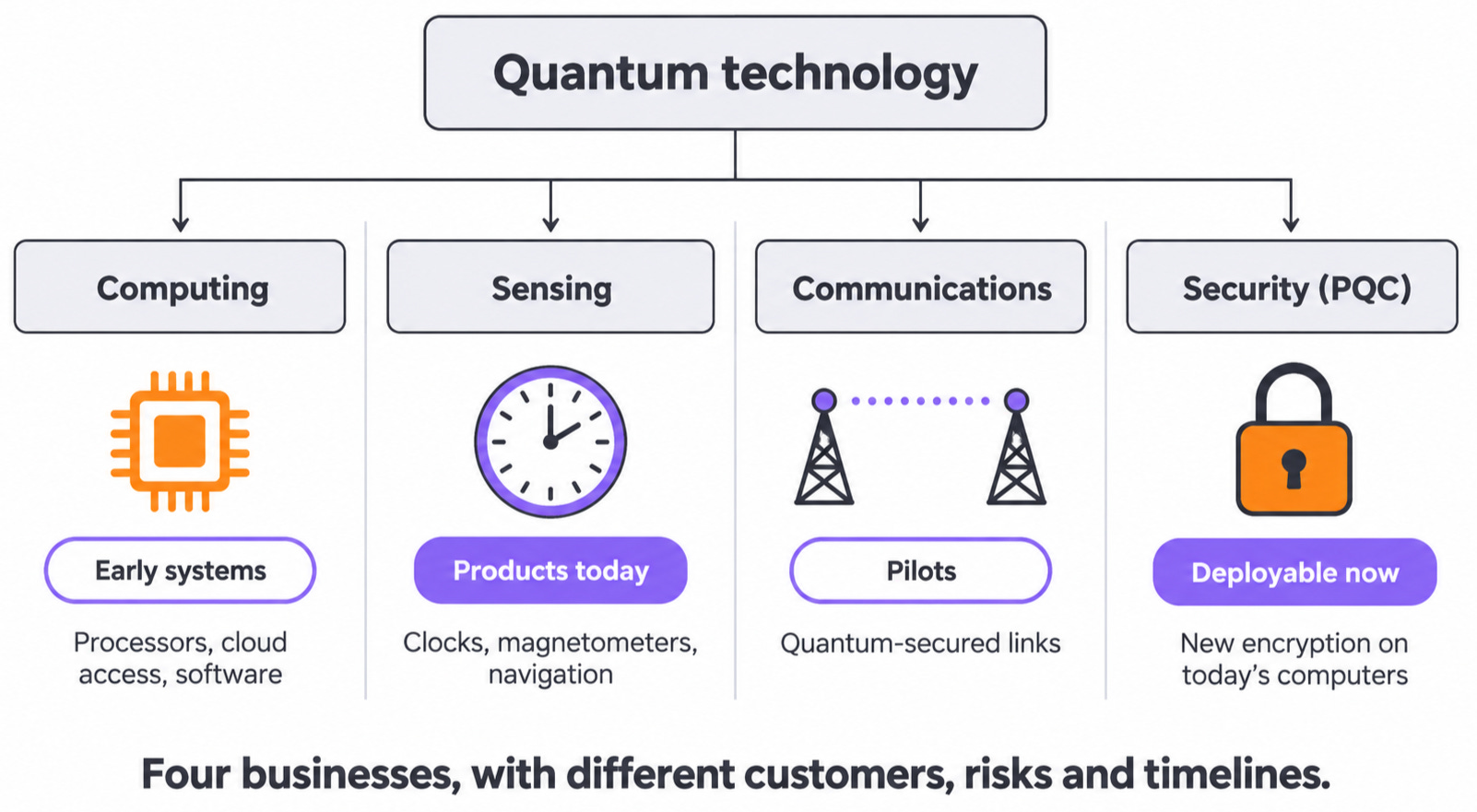
The money tells the same story. QED-C estimates the whole quantum industry sold $1.9B of products and services in 2025, while raising $4.9B of venture capital and attracting $12.7B of new government commitments. Capital is running well ahead of customers. That is normal for deep tech, but it tells you where to be careful.
The one idea you need
To see why computing is last in line, you need one idea. It isn’t “a qubit is 0 and 1 at the same time.” It’s interference.
Drop two pebbles in a pond and the ripples overlap. Where two peaks meet, you get a bigger wave. Where a peak meets a trough, the water goes flat.
Electrons do the same thing. Fire them one at a time at a wall with two slits, and each one lands as a single dot. But after thousands, the screen shows stripes, with bands where almost nothing lands. Opening the second slit actually makes some spots less likely to be hit. Balls can’t do that. Only waves can.
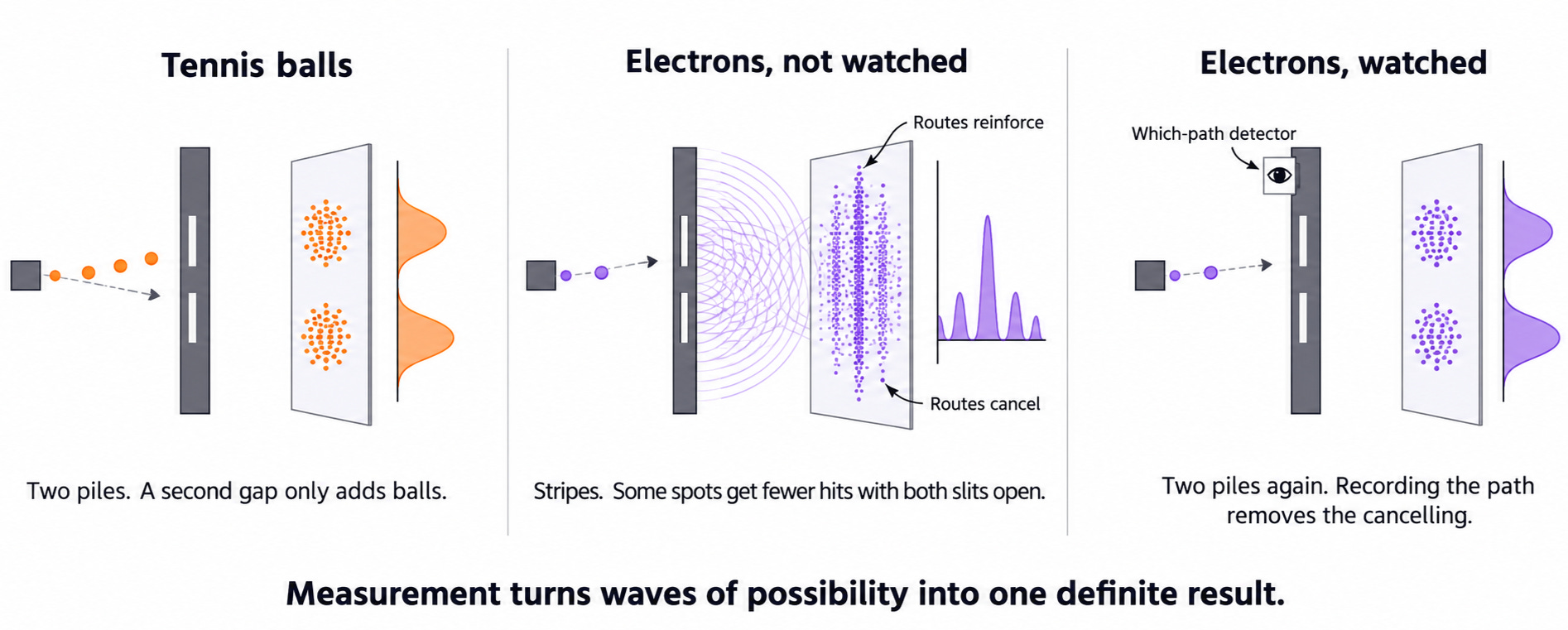
Now put a detector at the slits to see which one each electron goes through. The stripes vanish, and you get two plain piles, like tennis balls. Measuring the path destroys the interference. Stripes only form when each electron goes through both slits as a wave and the two halves overlap on the far side. A detector forces the electron to show up at one slit or the other, so there’s no second half left to overlap with.
That’s the whole game. A quantum computer is this experiment built on purpose. It sets up a calculation so the paths to wrong answers cancel out and the paths to the right answer add up, and only then does it measure. It doesn’t “try every answer at once.” It cancels the wrong ones.
That’s also why it only helps with problems that have the right structure, like breaking certain encryption or simulating molecules. It doesn’t help with email, spreadsheets or training today’s AI models.
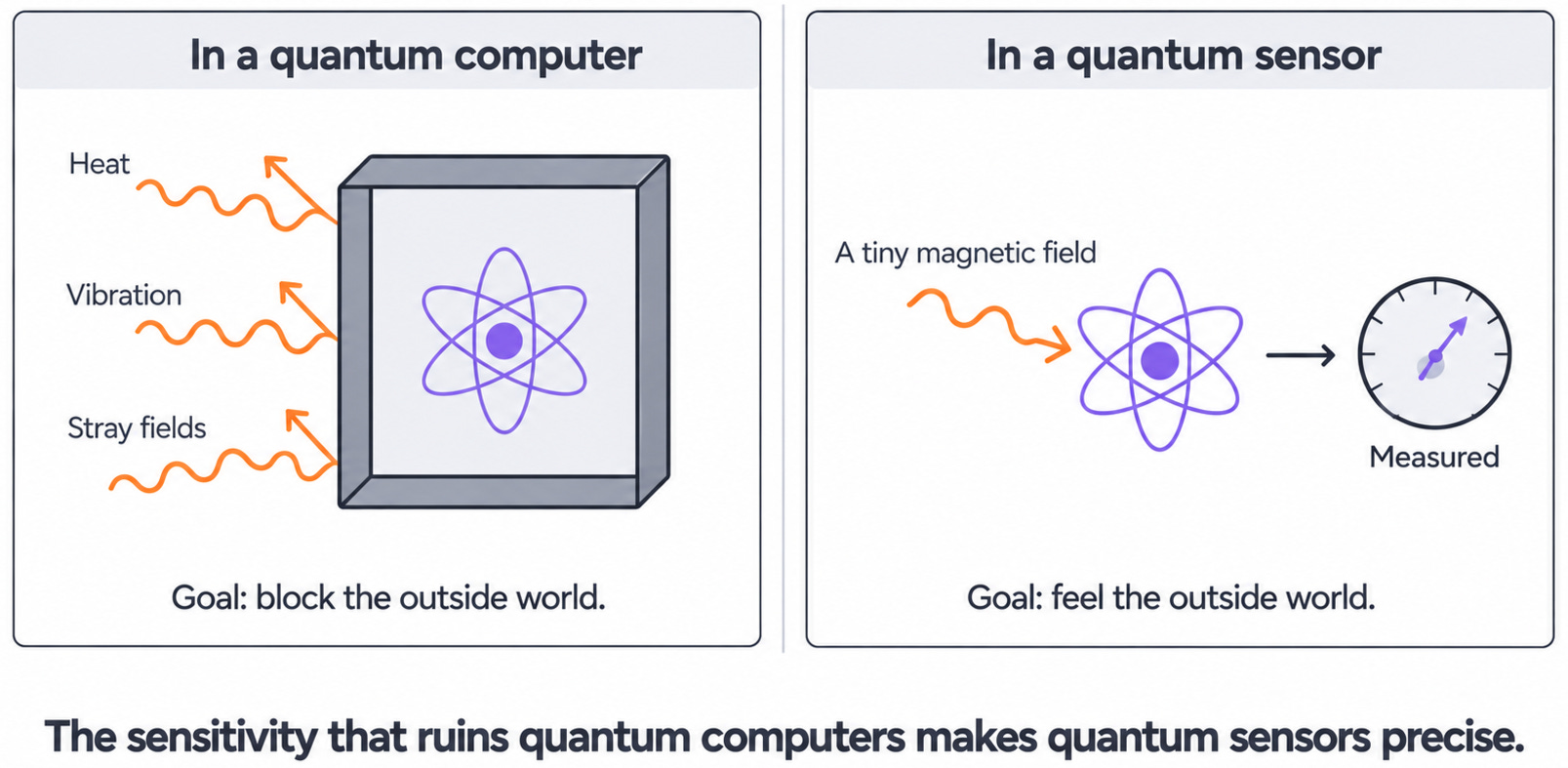
The same physics explains why these machines are so hard to build. Anything that bumps a qubit, whether heat, vibration or a stray magnetic field, acts like that detector at the slits and wipes out the interference.
Errors also compound fast. A qubit operation that works 99.9% of the time sounds excellent, but chain 1,000 of them together and the chance the whole calculation comes out clean is just 37%. Useful algorithms need millions to billions of operations.
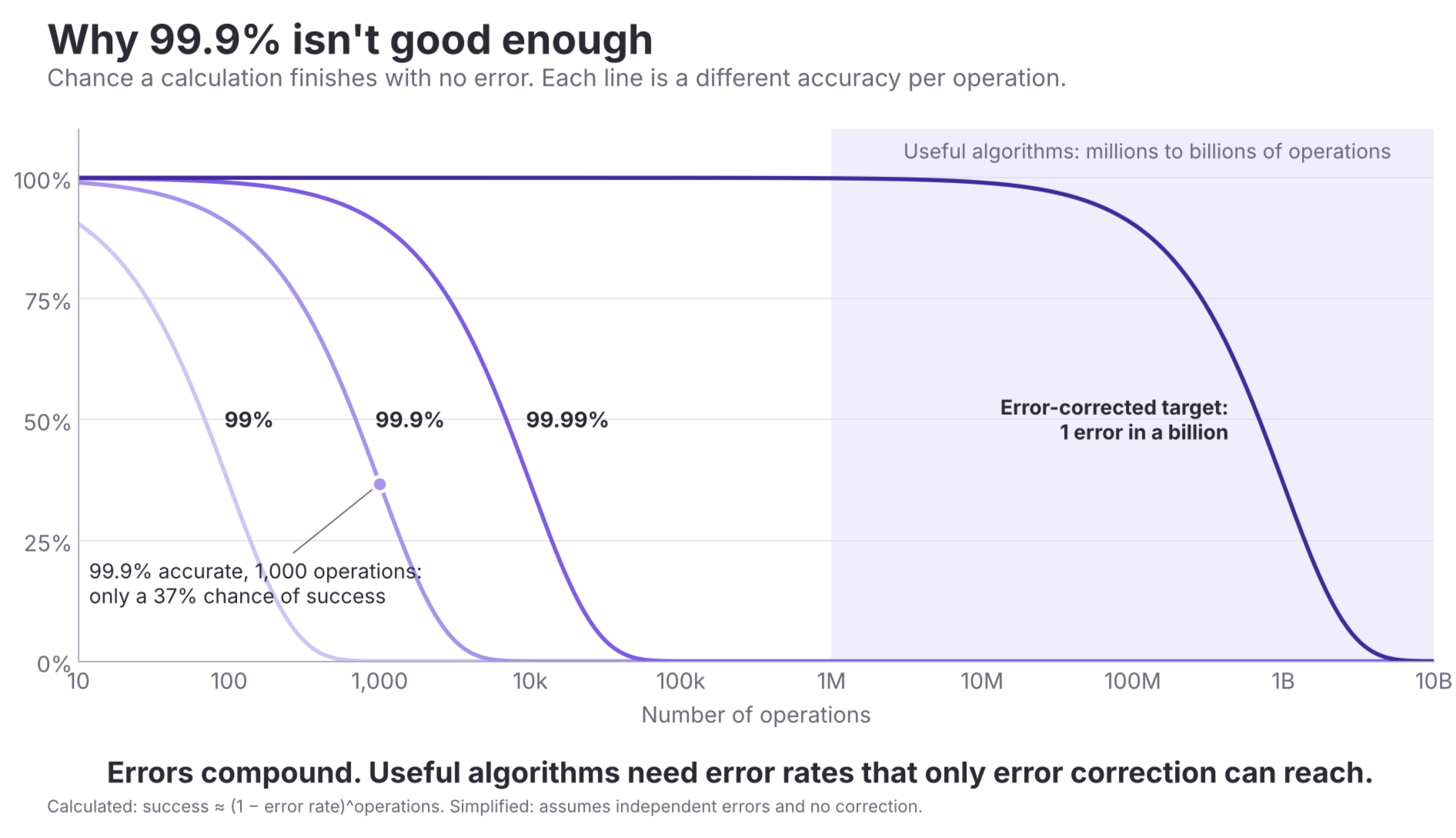
The answer is error correction: spread one reliable “logical” qubit across many physical ones and keep checking for mistakes without reading the data. This year it started working on a small scale. Quantinuum reported 99.9995% logical fidelity, and IBM and the University of Chicago ran 70 logical qubits.
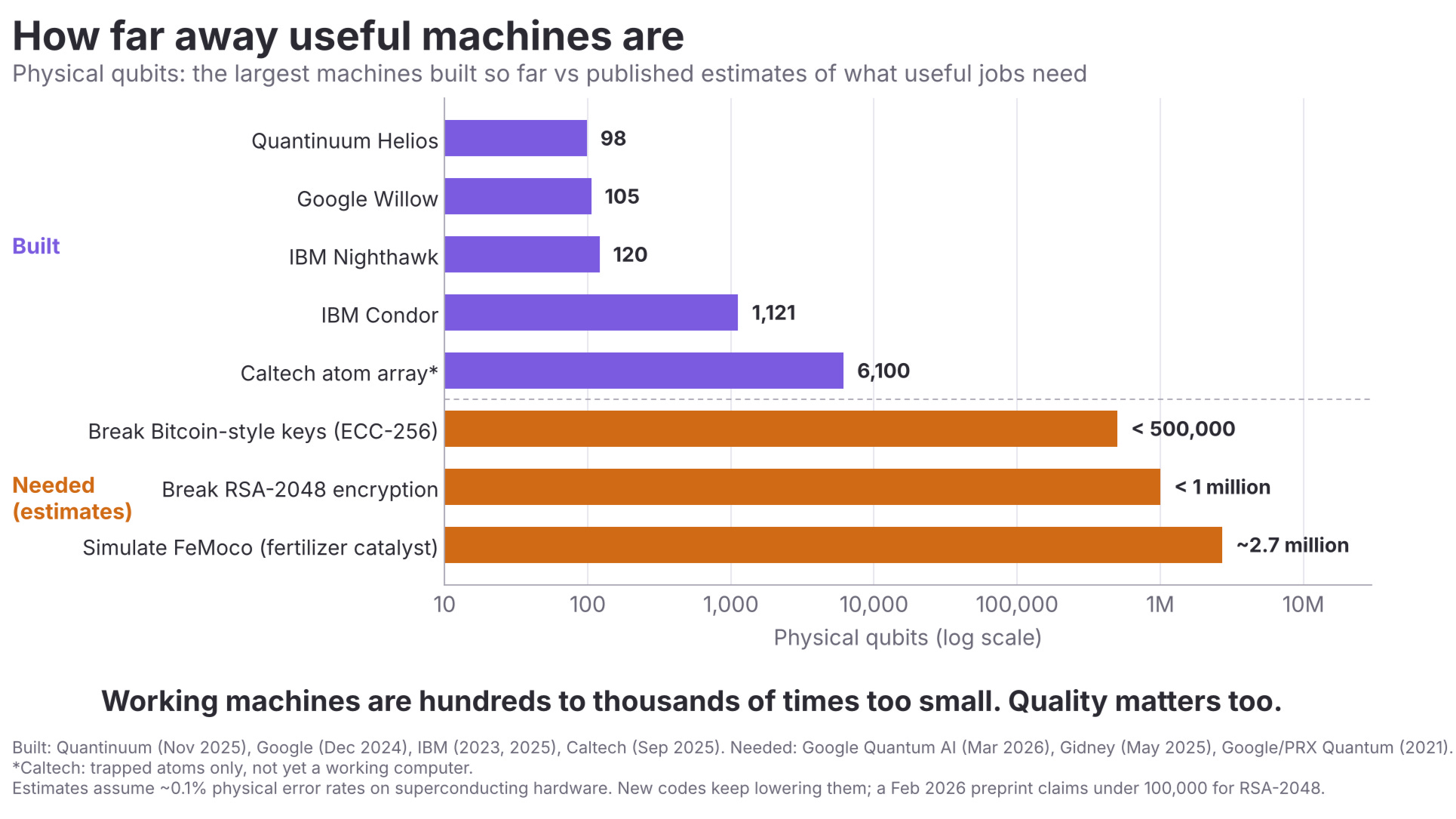
That progress is real. But the gap is still large. The best machines today have around 100 high-quality physical qubits. Published estimates for breaking RSA-2048 sit under a million, and useful chemistry needs comparable numbers. The estimates keep falling, which cuts both ways: good for the people building computers, bad for anyone relying on today’s encryption.
So where does value show up first?
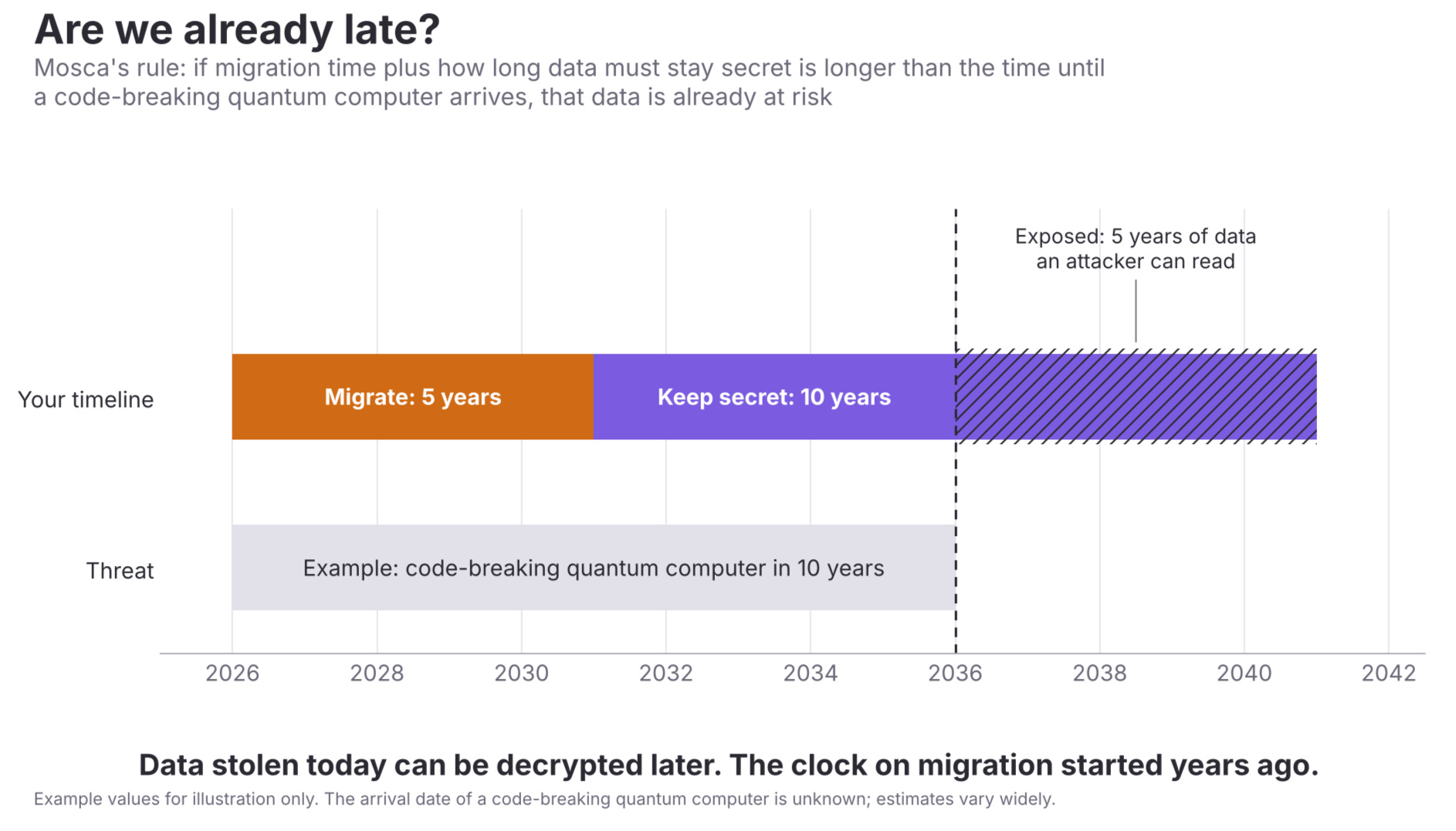
The clearest answer is security. The threat does not need a quantum computer to exist yet. An attacker can record encrypted traffic today and decrypt it later. Michele Mosca put it as a simple rule: if your data needs to stay secret for ten years, and moving to new encryption takes five, then you needed to start fifteen years before a code-breaking machine arrives. Nobody knows when that is, which is the point.
The new encryption already exists. NIST finalized its post-quantum standards in 2024, and Google has set 2029 to finish its own migration. The algorithms are free and standardized, so selling the algorithm is not a business.
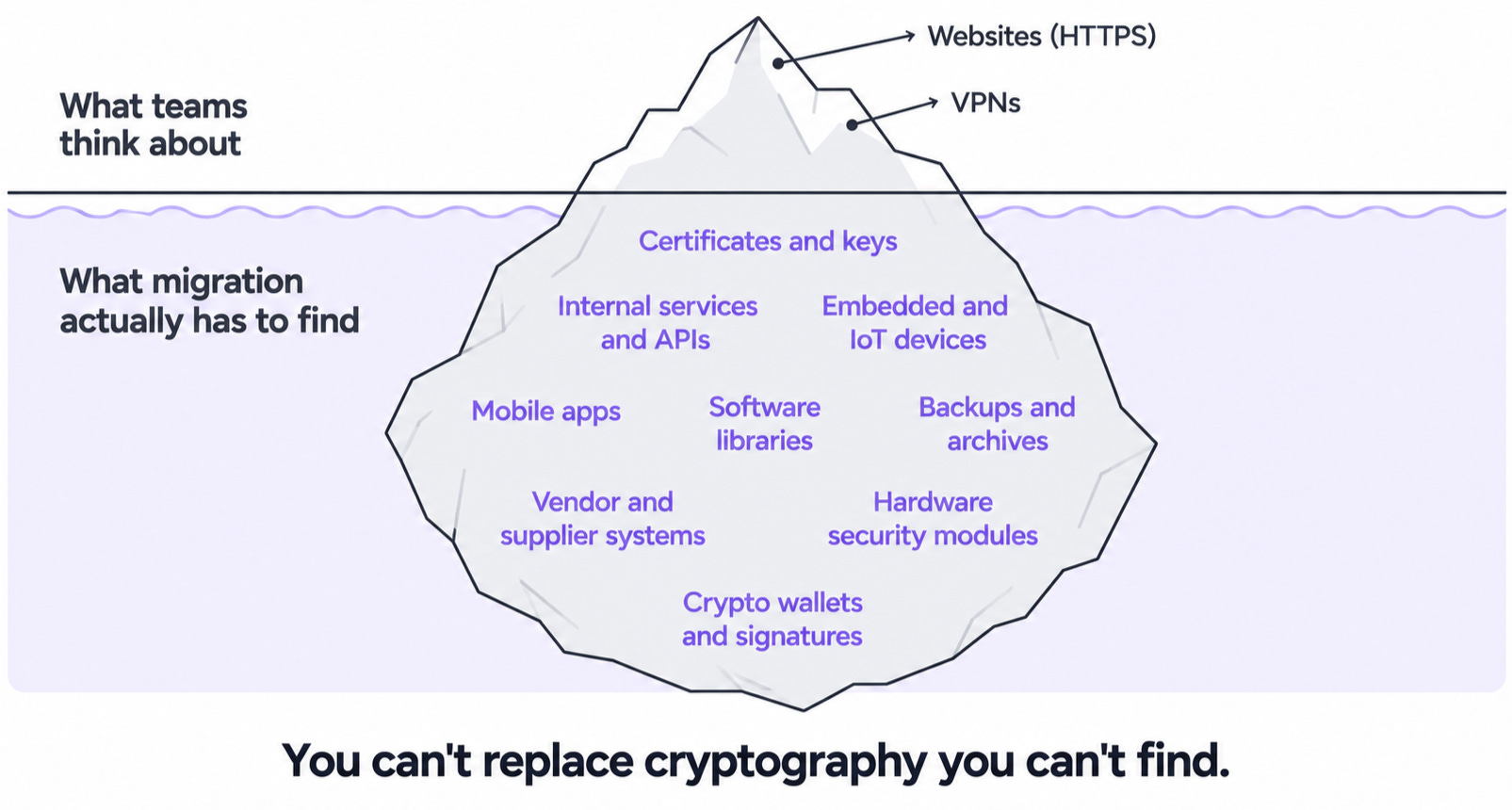
The hard part is finding where cryptography lives inside a large organization: certificates, internal APIs, embedded devices, vendor systems, backups. Most companies have no inventory. The startups worth backing own discovery and migration, the system of record for an organization’s cryptography, not a wrapper around a standard.
Crypto is a special case we care about. Google’s estimate covers the signatures that secure Bitcoin and Ethereum. Bitcoin merged BIP-360, its first quantum-resistant address type, this year, and Ethereum has a post-quantum team. The harder problem is governance, not math: who decides what happens to coins whose keys are already exposed, and how do millions of users migrate?
Sensing is the second answer, and it rests on an idea we found useful. The sensitivity that ruins quantum computers is exactly what makes quantum sensors precise. A computer tries to block out the world. A sensor tries to feel it.
Atomic clocks have been products for decades. The new wave is navigation that works when GPS is jammed, plus magnetometers and gravity sensors, and defense is the first buyer. The test is simple to state and hard to pass: field data, in a package of the right size, weight, power and cost, against the best classical sensor rather than an old one.
The third answer is the enabling layer. Nobody knows which way of building a qubit will win: superconducting circuits, trapped ions, neutral atoms, photons or electron spins. Every one of them needs control electronics, cryogenics, lasers, photonics, calibration software and fast classical processors to decode errors. A company that sells to all of them does not have to pick.
The risks are a small customer base and the chance that the big hardware makers bring it in-house.
The part closest to our AI work is AI for quantum: using machine learning to calibrate, control and debug these machines, which can be tested today by how much calibration time it saves.
We put the longer version on Canonical Labs: an interactive two-slit experiment, an error calculator, a Mosca calculator and the gap between the machines we have and the ones we need. Explore it here. If you are building in post-quantum migration, quantum sensing or the enabling stack, and you want to change how the world works, we want to meet you.