
I watched the Google-Microsoft search wars in 2009. Everyone said Bing was DOA. Google had the algorithms, the data flywheel, the users. Microsoft had... Bing Rewards.
Except that wasn’t the whole story. Microsoft quietly built out Azure, bought LinkedIn and GitHub, and became the operating system for how companies actually work. They couldn’t beat Google at search. But they used the war chest and expertise to cement Azure in the enterprise.
I’m getting the same feeling now.
Google is chasing the biggest possible models: general, consumer-facing, embedded in Search, Gmail, Docs. Microsoft is playing a different game: quietly shipping small language models tuned for narrow tasks, enterprise workflows, and on-device agents.
Same rivalry. Different weapons.
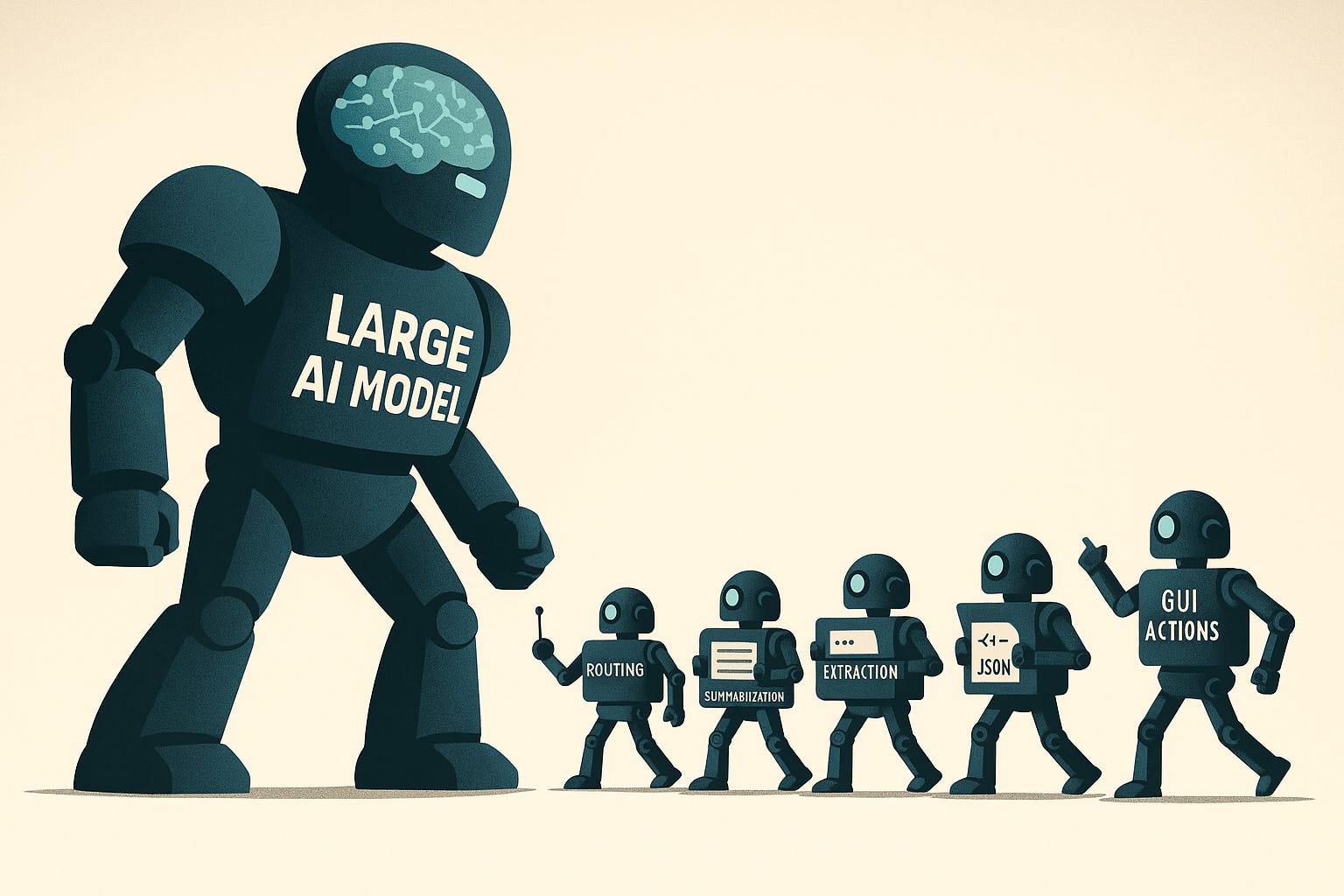
Why small models matter
We’ve been trained to think more parameters = more intelligence. But recent results say otherwise.And neuroscience is now backing that up: modeling language more accurately doesn’t make a model capable of thinking.
LLMs remix patterns in text: they don’t form concepts, understand causality, or build internal models of the world. Bigger models get better at sounding smart, not at thinking smart. That’s a dead end for enterprise use cases that require grounded decisions, not verbal performance.
This shift is about hitting diminishing returns at scale. We’re starting to see signs that simply piling on more parameters yields less marginal gain. What’s changing faster is the quality of data and how post-training is targeted.
It turns out, teaching a model to be a PhD in one subject is easier and more useful than forcing it to be a mediocre polymath.
Mistral 7B, a 7B open model, beats LLaMA-2 13B across all reported benchmarks, and even rivals a 34B model in many tasks. Half the size, better results.
DeepSeek-R1-Distill-Qwen-7B, a 7B open model, surpasses the 32B QwQ-32B-Preview on the AIME 2024 math competition benchmark (55.5% vs ~50%) and scores 92.8% on MATH-500, outperforming GPT-4o on mathematics tasks despite being a fraction of the size.
Microsoft’s Phi-3 models (3.8B–14B) hit 75-78% on MMLU, matching or surpassing much larger models. Phi-3-mini at 3.8B outperforms models twice its size on language, coding, and math.
NVIDIA’s position paper, “Small Language Models are the Future of Agentic AI”, argues that for AI agents doing repetitive, narrow tasks, SLMs are “sufficiently powerful, inherently more suitable, and necessarily more economical” than giant LLMs.
Recent research on multi-agent scaling and compute tradeoffs shows that how you divide work, manage compute, and keep things efficient matters a lot. In many cases, multiple small models working together can outperform one big one, especially when cost, latency, or control matter.
Baguettotron, a 321M parameter model from Pleias, beats much larger models on reasoning benchmarks using deep architecture (80 layers) and high-quality synthetic data, which is proof that smart design can outperform raw scale.
A recent HBR article notes that leading players like IBM (Granite) & Apple (OpenELM) are now releasing compact models designed for energy-efficiency and ease of deployment, not just Microsoft. Apple’s OpenELM family (270M–3B parameters) and the small on‑device models powering Apple Intelligence show what an “SLM‑first” strategy looks like at global scale. Billions of daily inferences happening directly on iPhones, iPads, and Macs, with no cloud dependency. Apple’s entire AI philosophy hinges on small, private, efficient models running locally.
The pattern: with good data and targeted training, a 7B model can match or exceed 30B+ models on many real tasks while being faster, cheaper, and easier to deploy.
This is why small models thrive: if language ≠ intelligence, scaling language models alone won’t produce reasoning.
Real deployments, not hype
The Wall Street Journal captured this shift well in “Large Language Models Get All the Hype, but Small Models Do the Real Work”.
Talk to companies actually using AI and you see the same architecture:
an AI assembly line: conventional software as the conveyor belt, and many small models as the workers.
A few concrete patterns:
Gong – In sales analytics, Gong sends a high-level question (e.g. “why are deals slipping?”) to a frontier model once, then uses cheaper small models to trawl tens of thousands of calls, summarize them, and extract patterns before handing it back to the big model for a polished explanation (WSJ breakdown). That shift – one expensive call, many cheap ones – is the difference between “cool demo” and “sustainable product.”
Airbnb – CEO Brian Chesky has said they don’t run OpenAI’s latest frontier models in production because of cost and latency. Instead, Airbnb’s in-app support uses a mix of 13 models (OpenAI, Google, Alibaba’s Qwen, open-source) orchestrated together. That’s an SLM mindset: right-size every step to keep speed and margins sane.
Meta (ads) – Meta uses its largest models offline to train more compact ad-ranking models, then runs those lightweight versions in production for every auction (WSJ). The giant LLM is the teacher; the small model is the worker.
And then the very small:
PPGWeaver from Synthefy – a time-series project where sub-2k-parameter models (yes, thousands, not billions) estimate heart rate from wearable sensors in under 40ms on a 64MHz microcontroller. Synthetic data + pruning beats larger baselines, and you can deploy it literally on a watch.
In the creative and vertical world:
Information Lattice Learning (ILL) – a compact non-neural model that rediscovered much of Western music theory from 370 Bach chorales, not as embeddings but as human-readable rules.
Kocree – builds on ILL to create Muosaic, a co-creation platform where music is composed from traceable fragments. The AI can say “this phrase is 3 parts Bowie, 1 part Lou Reed” and assign credit. This is a small, structured, interpretable system – the opposite of a gigantic black-box generator.
And Microsoft’s ecosystem:
Phi-3 – small models being piloted with Epic in healthcare documentation, Fidelity/Saifr in compliance, Digital Green in agriculture, Khan Academy for tutoring. These are places where running a 70B model on every interaction is just not economically viable.
These examples don’t look like the glossy “general AI assistant” demos. That’s the point. They’re small, narrow, embedded, and they’re doing real work.
Energy and economics: the part nobody wants to talk about
Energy & AI is like climate change: most realize the problem, few are actually doing anything about it.
Training one frontier LLM can consume as much electricity as thousands of homes over a year. Training a small model is still expensive, but one to two orders of magnitude lower. The same asymmetry exists for fine tunings and RAM requirements.
At production scale, inference dominates: if you serve millions of queries per day, running a 70B model everywhere can burn a shocking amount of GPU time (and carbon). Replace 90% of those calls with a 7B model (whether fine tuned or with an expert prompt), and the bill (and the energy footprint) drops dramatically – all with acceptable losses of nuance and accuracy.
Smaller models also unlock more available, commodity hardware, reducing bottlenecks further. According to HBR, SLMs typically require 30-40% of the compute of LLMs and are far more deployable across mobile devices, factory equipment, and field. That means smarter systems in more places, not just the cloud.
This is why hospitals, banks, and airlines are not going to spray giant LLM calls across every micro-interaction in their systems. They will:
use one large model where it materially changes the outcome, and
rely on small, specialized models for the steady-state work: routing, extraction, formatting, ranking, forecasting, GUI actions.
Open Questions
Small models are winning today’s AI economics. But a few forces could swing the balance back:
Will token costs collapse the arbitrage? Token prices have dropped ~300x since GPT-3, and they’re still falling. If frontier inference gets cheap enough, the cost advantage of SLMs narrows, and convenience wins. But there’s a catch: cheaper inference doesn’t always mean lower spend. Thanks to the Jevons paradox, dropping costs often drive up usage. The real risk isn’t that LLMs get cheaper. The real risk is that we start using them everywhere, and total compute (and cost) still explodes.
Can anyone actually manage an SLM fleet? Fine-tuning sounds appealing until you’re running dozens of models, each needing retraining, drift monitoring, safety evals, and prompt maintenance. At some point, one stable upstream LLM starts looking simpler.
Is context the real moat? Frontier models now handle 128k+ token windows—entire customer journeys, legal docs, codebases in one shot. SLMs are narrow by design. For workflows that need full-context reasoning, that’s a hard constraint.
Do reasoning capabilities require scale? Chain-of-thought, tool use, and retrieval are increasingly distillable into smaller models. But if some capabilities turn out to be emergent properties of scale, SLMs hit a ceiling.
Does hybrid just win? The likely answer is both: Claude or GPT-5 for planning, Phi or Fara for execution. The real question becomes unit economics. Is it cheaper to fine-tune and host a fleet, or just call GPT-4o at $2 per million tokens?
Right now, SLMs are the scrappy, capital-efficient bet. But if the token cost floor collapses or the ops burden compounds, enterprises may consolidate back to frontier APIs.
And if the Futurism analysis holds that LLMs can never move beyond probabilistic remixing then giant LLMs may plateau earlier than expected.
Where this goes next
The strategic picture looks like this:
Google is building ever-bigger, ever-more-general LLMs and wiring them into consumer products. Their bet: whoever owns the “universal model” and its distribution wins.
Microsoft is quietly seeding the world with small, specialized models – Phi for language, Fara for computer use, vertical SLMs for healthcare, finance, automotive – and letting enterprises run them on their own hardware, under their own data policies.
In that world, the winner isn’t who has the single biggest model.
It’s who controls the ecosystem of small models that actually live inside products, workflows, and devices.
Google might end up owning the consumer-facing flashy “AI layer” of the public web.
Microsoft looks determined to own the millions of small brains on the ground.
If the last decade of cloud taught us anything, it’s this: margins and energy bills quietly shape architecture. When that logic hits AI, the war between “bigger” and “smaller” won’t be decided on model performance alone – it’ll be decided in P&Ls and power meters.
And on that axis, small models are a much more dangerous weapon than most people realize.
Special thanks to Harrison Dahme, Dr. Somi Agarwal (Synthefy), Prof. Lav Varshney (Kocree) & Anthony Avedissian for their thoughtful comments and helping refine this article.