
Over the past few years, Canonical has been laser-focused on “Decentralized Intelligence.” During our AGM last week, we presented our investment thesis and why we are excited about backing founders building in this category.
We first explained how AI is compounding fast and centralizing faster, then evidenced how Decentralized AI is working and growing, and finally painted a picture for the dawn of the Intelligence Age.
We want this work in the open, so we are publishing the content here for founders and LPs to build upon.
The Acceleration of AI
Before diving into decentralized AI, we grounded LPs in just how rapidly AI is infiltrating our daily lives and scaling in the real world.
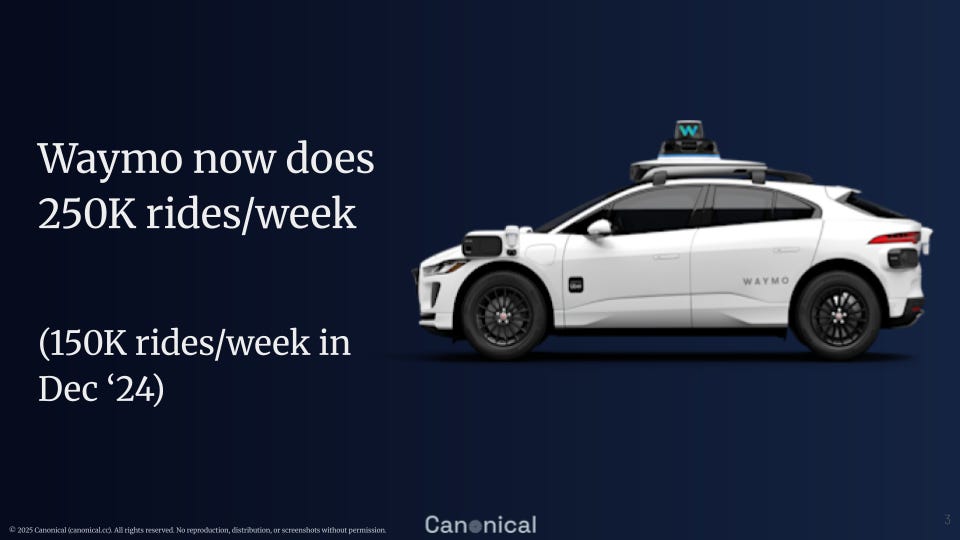
Consider autonomous driving. Waymo now completes 250,000 autonomous rides/week, up from 150,000 per week at the end of 2024. It’s a clear signal: AI is in production, touching people’s daily routines, and scaling at a pace we’ve never seen before. And this same acceleration is playing out across many other sectors.
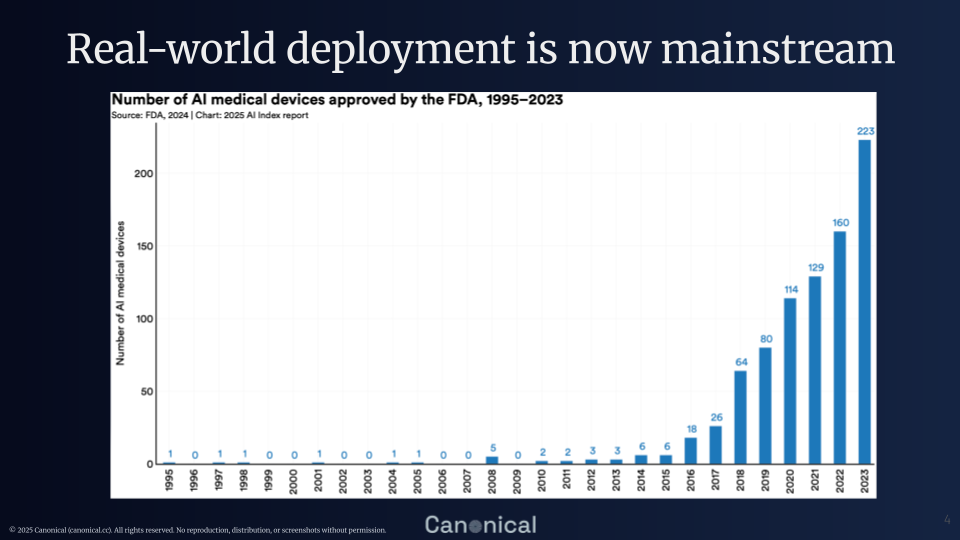
AI is becoming mainstream even in traditionally slow-moving fields like medicine. The notoriously cautious FDA approved just 6 AI-based medical systems in 2015, but by 2023, that number jumped to 223. If even healthcare regulators have greenlit AI tools, it shows just how quickly AI is being adopted across the board.
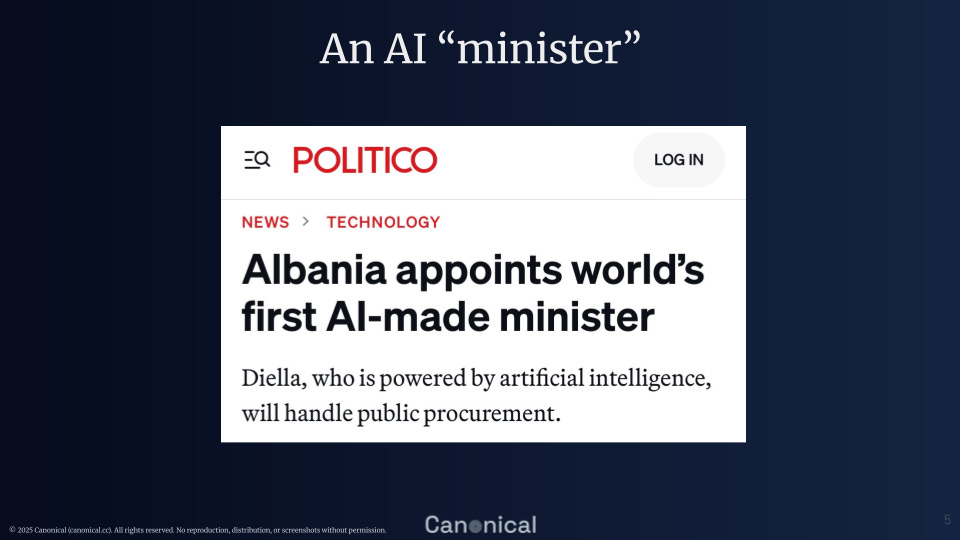
Even governments are experimenting: Albania recently appointed an AI system to oversee public contract bidding, effectively acting as a digital “minister” to reduce corruption, bias, and inefficiency. And we don’t believe this is the last we’ll hear of this. Soon, we expect AI to appear in boardrooms and governments and become a key part of the administrative process.
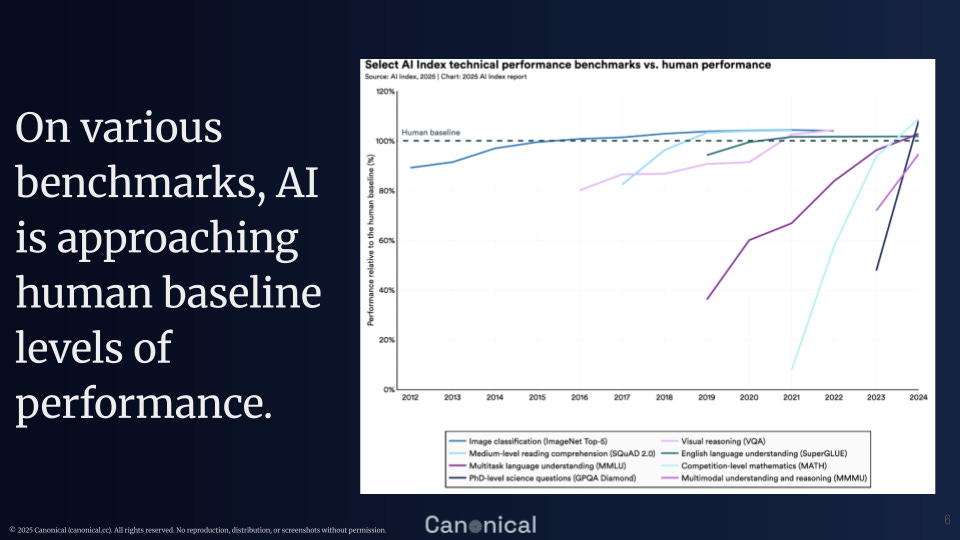
Whether it’s language understanding, reasoning, or even PhD-level science questions, performance is rapidly converging on, and in some cases surpassing, human baseline levels. The takeaway is simple: AI is performing at or above human capability in areas we once thought uniquely human.
That acceleration is what makes decentralized approaches urgent. If this power is inevitable, the real question is: who controls it, and how is the value captured?
The Risks of Centralized AI
Behind this progress lies a troubling trend: frontier models are becoming prohibitively expensive. Training costs are projected to exceed $1 billion per model by 2027. Meanwhile, Anthropic’s CEO, Dario Amodei, predicted that next year, training costs for AI models “may be above $10 billion” and that “model companies will have ambitions to build $100 billion training clusters.”
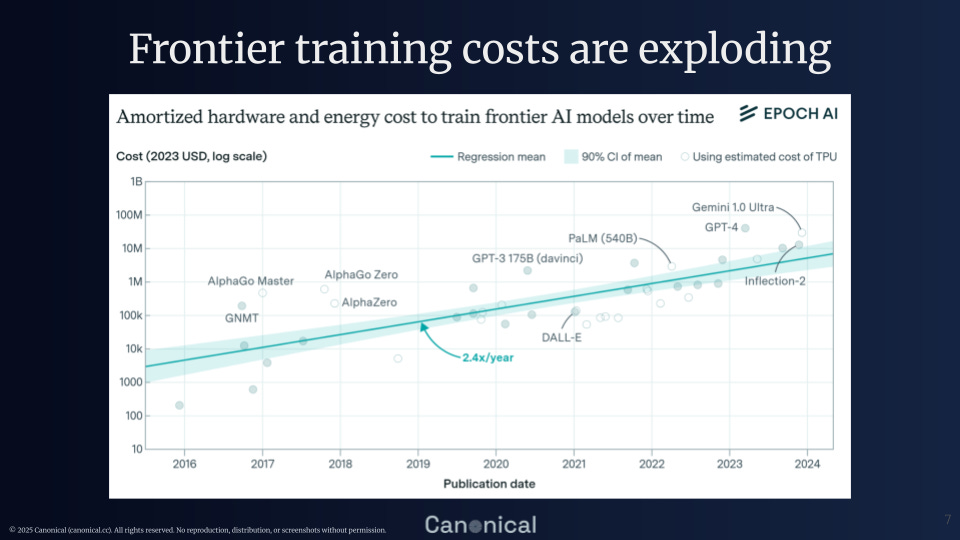
That reality locks out all but a handful of well-funded labs, which operate in a very closed, opaque way, reinforcing a highly centralized model of development.
The risks of such centralization are profound:
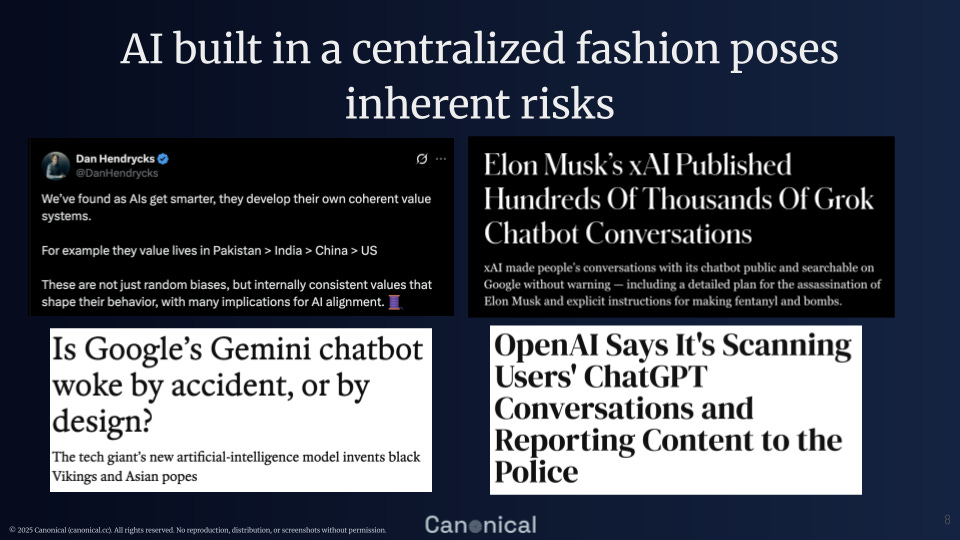
Bias & ethics - With only a few firms controlling frontier models, embedded biases scale globally and are nearly impossible to audit or correct.
Security - Centralized models become single points of failure; if compromised or misused, the fallout can disrupt entire industries.
Privacy - Sensitive data flows into a handful of corporate servers, concentrating risk and making surveillance or misuse almost inevitable.
Transparency - Users can’t independently verify what models they’re interacting with or how they’re updated, leaving trust as blind faith in providers.
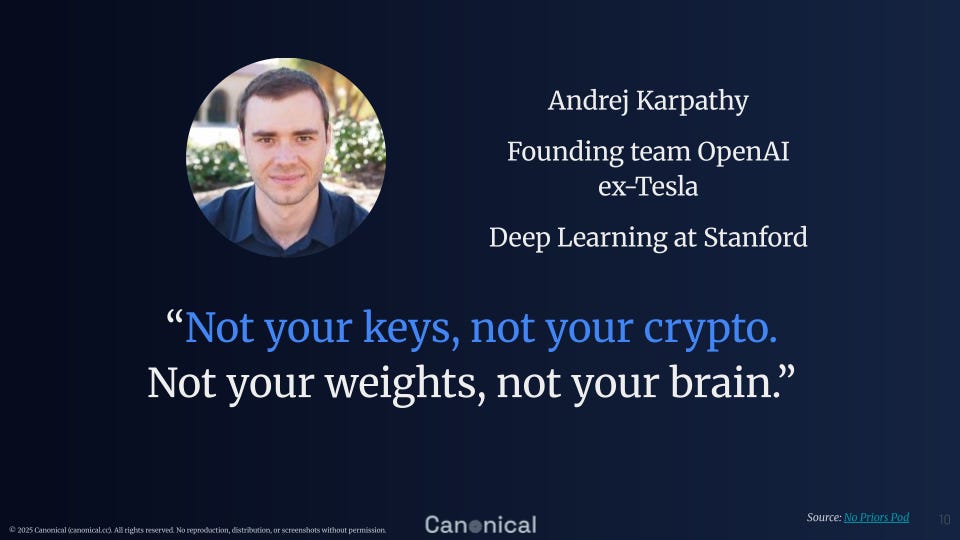
Crypto taught us a simple rule: “Not your keys, not your crypto.” If your assets sit on Coinbase or Binance, you don’t really own them. The exchange does. If the exchange freezes, gets hacked, or collapses, you could lose everything.
Andrej Karpathy, a founding member of OpenAI, extends this logic to AI: “Not your weights, not your brain.” In AI, the “weights” are the parameters that give a model its intelligence, like its memory and instincts. If you don’t control the weights, then you’re just renting intelligence. It’s like outsourcing your brain; if access gets cut off or the provider changes the rules, you’re powerless.
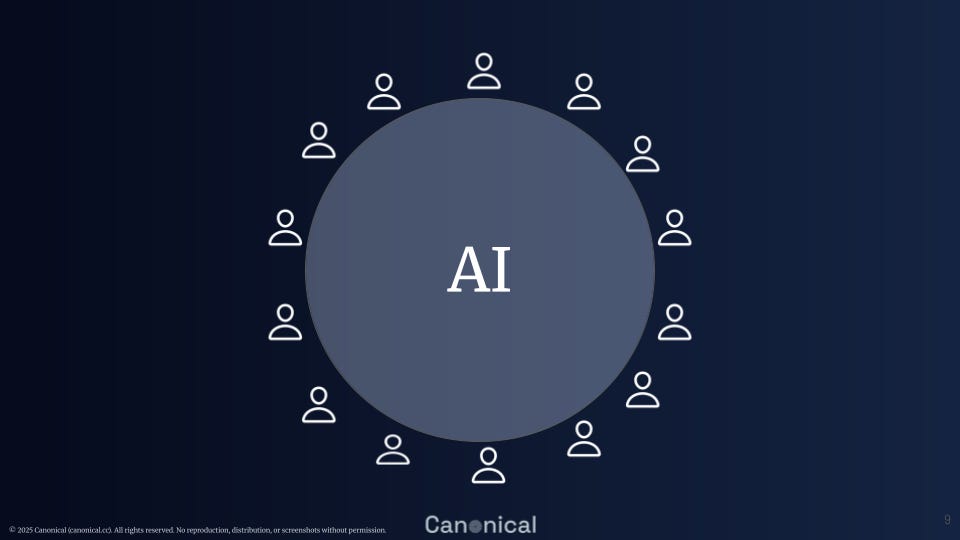
That’s why sovereignty over intelligence matters. AI is fast becoming the command center of daily life. One system, one stack, one monoculture. It collects our data, tailors the world back to us, and feels helpful, even deferential. But the risk is quieter: a centralized AI doesn’t need to lie to steer you; it just decides what to reveal and what to conceal, and your reality tilts.
We’re trading our most sensitive information for convenience. And in return, the system learns how to nudge us. That’s the path we’re on – unless we build a decentralized alternative.
Why AI Must Decentralize
Open-source AI is a step forward - open models, like Deepseek’s or Mistral’s, are quickly closing the gap with closed labs. That means the big proprietary advantage is diminishing; there’s not much defensibility in keeping models closed.
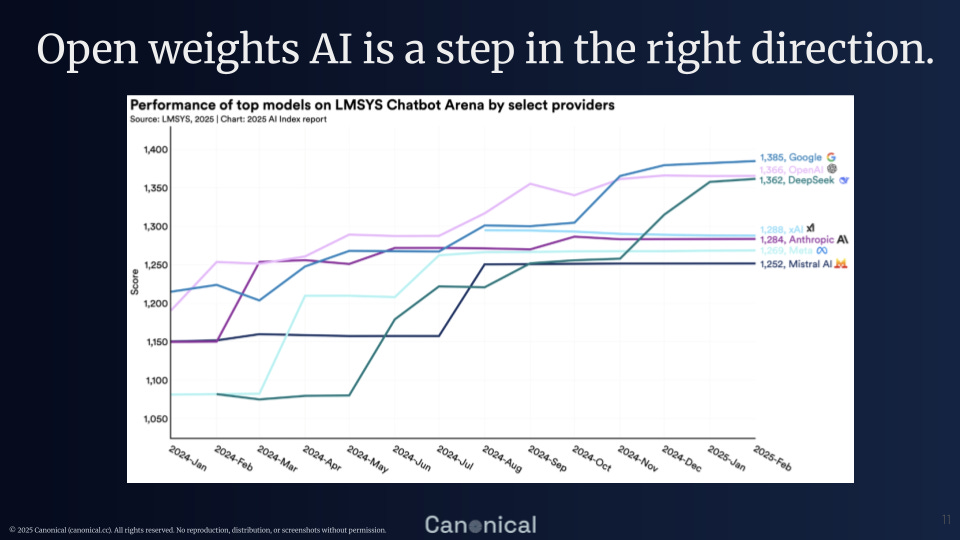
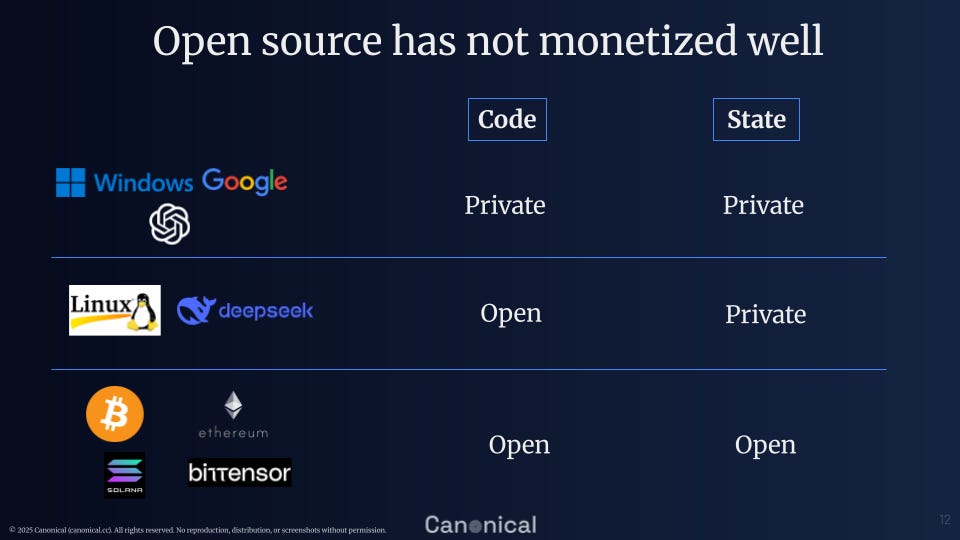
But openness alone isn’t enough. Historically, open-source has struggled to monetize because, while code is free, usage data and state are controlled by platforms.
Think of Windows or Google: all proprietary code and their data are closed off.
Even with truly open AI models, you might release the model weights, but the usage data and the way the model is actually run (the state) can still get siloed by whoever deploys it.
Blockchains fundamentally change this dynamic. They make both the code and the state open and enforceable. Smart contracts are open-source, and their state (balances, transactions, governance) lives on a public ledger, not in any one company’s server. This means the value created by an open protocol can be captured by the network rather than just a platform.
Applied to AI, it means models can be open-source, with usage data, incentives, and governance embedded directly into the network.
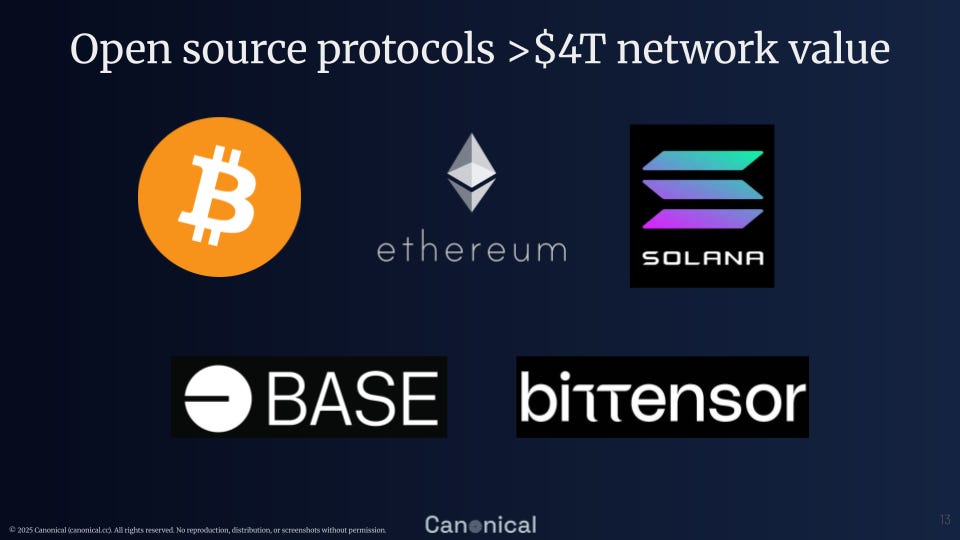
The good news is we have a precedent for this kind of decentralization. Open protocols like Bitcoin and Ethereum have shown that incentives can coordinate resources on a civilization scale, sustaining multi-trillion-dollar networks without central control.
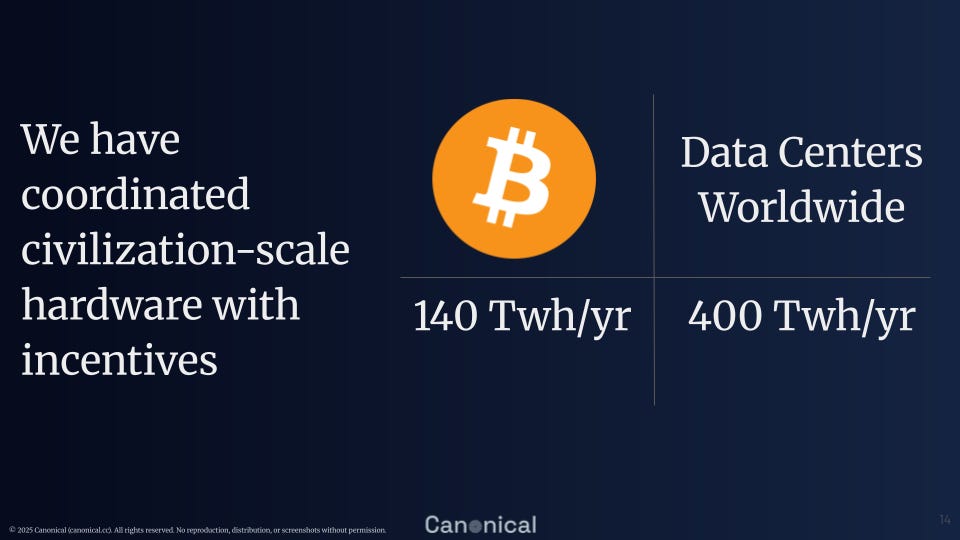
Bitcoin alone secures a global network of machines consuming ~140 terawatt-hours per year of compute, about a third of all data centers worldwide, driven purely by economic incentives. From the bottom up, Bitcoin created the infrastructure for truly decentralized money. That same incentive architecture can now build truly decentralized intelligence.
The Decentralized AI Stack
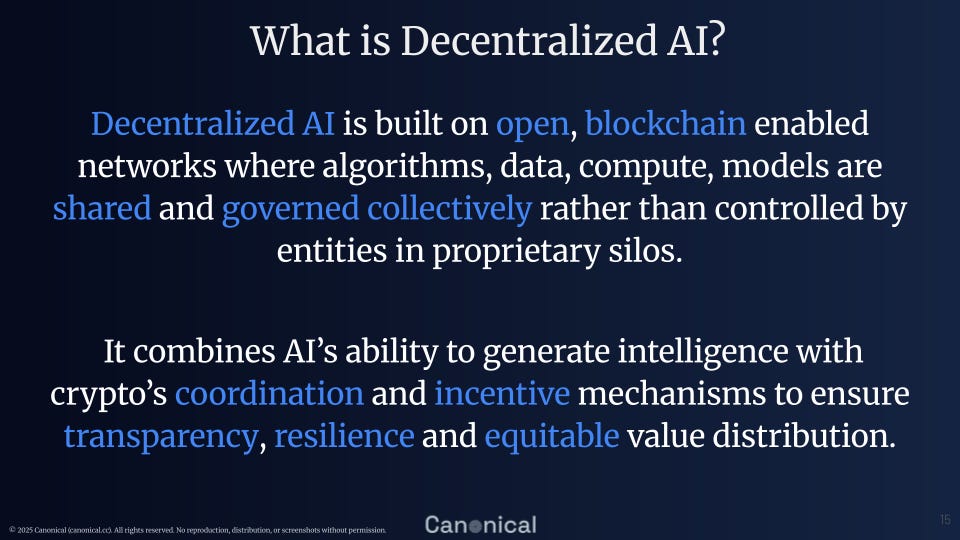
When we say “Decentralized AI,” we mean AI built on open, blockchain-enabled networks where algorithms, data, compute, and models are shared and governed collectively rather than controlled by entities in proprietary silos.
It combines AI’s ability to generate intelligence with crypto’s coordination and incentive mechanisms to ensure transparency, resilience, and equitable value distribution.
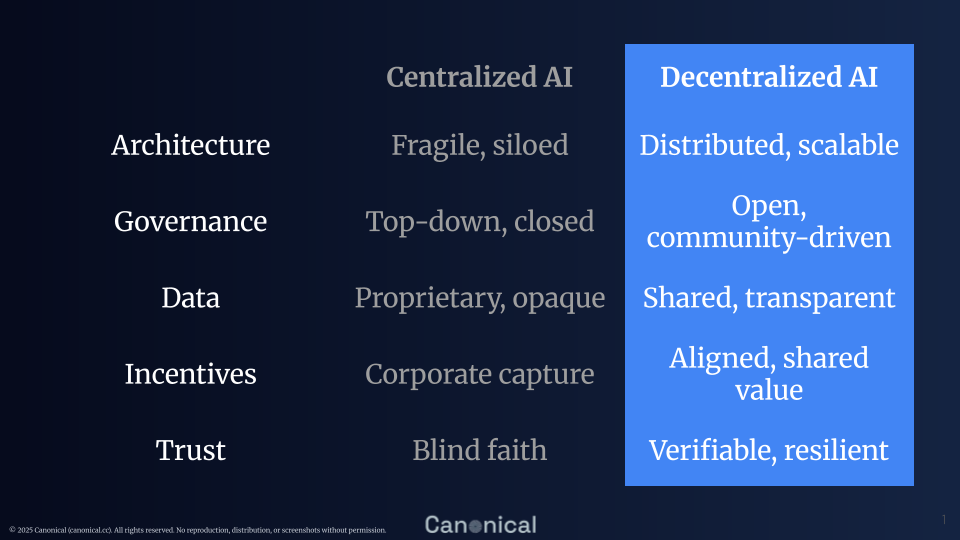
Decentralized AI isn’t just an alternative. It’s a fundamental shift across every layer that matters. How systems are built, governed, sustained, and trusted. These are the core principles across the five vectors that really matter:
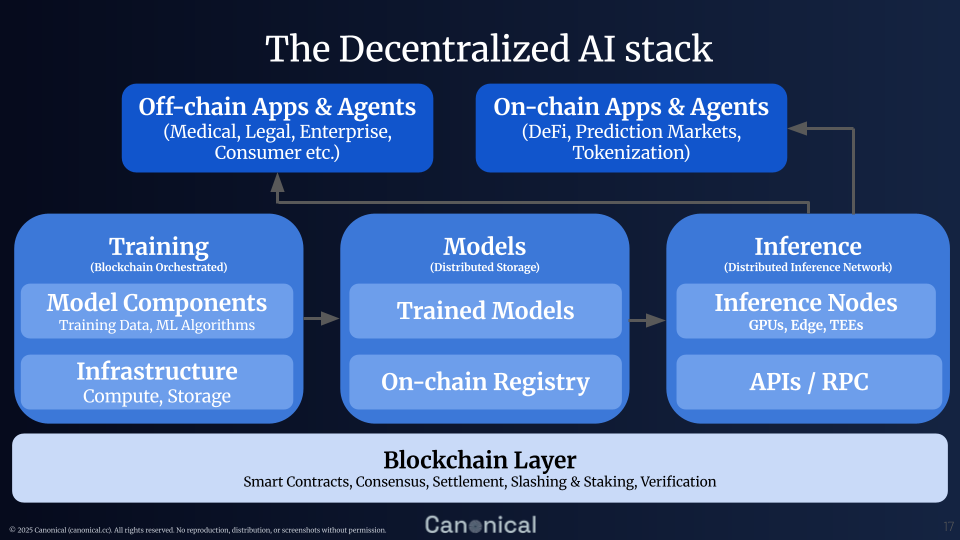
We view decentralized AI as a layered architecture, much like the internet, where each layer builds and compounds on the one below. At the foundation are blockchains. After years of bottlenecks, performant chains like Solana and Base are finally fast, cheap, and globally scalable.
On top of that base sit the key layers where decentralized AI takes shape:
Verifiable data & labeling to ground models in transparent information
Model training & inference secured by cryptoeconomic guarantees
Execution & oracle layers to protect against fraud and bias
Agents & applications where end users interact with intelligence
Each layer has distinct investable choke points - opportunities for defensibility and value accrual - while the stack as a whole reflects the convergence of crypto’s coordination and AI’s intelligence.
Market Opportunity
If the stack shows how decentralized AI can be built, the natural next question is how big could this become? Sizing this opportunity is not straightforward, because crypto doesn’t just disrupt existing markets - it also consistently creates new markets and new forms of value (our portfolio company Virtuals is a great example of this).
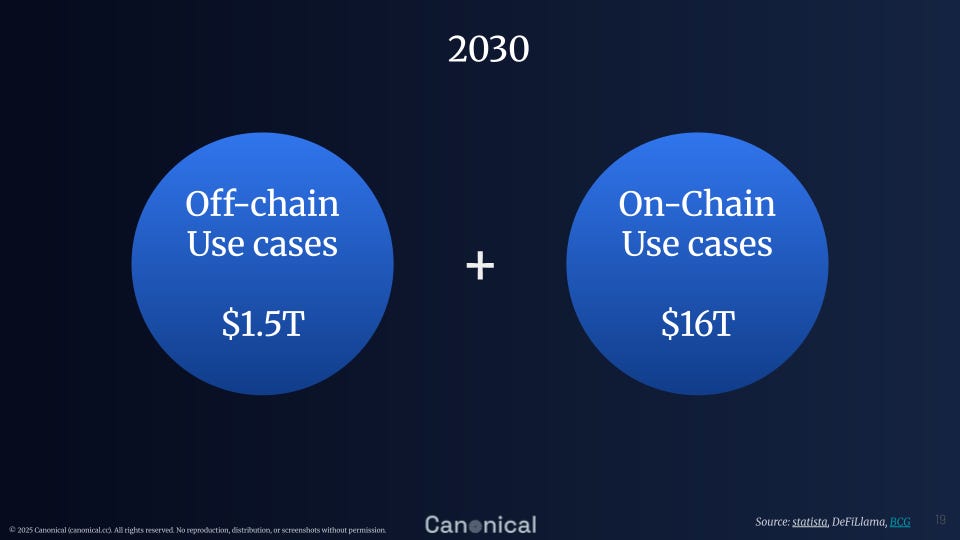
Even through a conservative lens, the scale is striking. Today, the AI market is valued at $300 billion and is expected to grow to $1.5 trillion by 2030. Meanwhile, onchain assets are currently valued at $400 billion and are projected to reach $16 trillion by 2030.
Decentralized AI sits directly at the intersection of these two growth curves, positioned to capture value from both the growth of AI and the migration of assets onto blockchains. At Canonical, we aim to support companies that build the infrastructure that connects them.
To reiterate: at our stage (pre-PMF), we’re not just tapping into existing markets, we’re helping create entirely new ones. Decentralized AI is truly a new investable category in its own right.
Proof That Decentralized AI Works
Decentralized AI is already working in practice - we highlighted three examples from our portfolio with tangible traction, inviting the founders to share recent updates: EXO Labs, Sahara AI, and Ritual AI.
Here, @alexocheema, the founder of @exolabs, shares his perspective on building in decentralized AI.
And @xiangrenNLP, founder of @SaharaLabsAI.
And @niraj, founder of @ritualnet.
Why Now Is the Moment
After establishing why decentralized AI is important, we outlined five reasons why now is the perfect time to invest at the early stages of this cross-section.
1. Always follow the talent. The decentralized AI space is attracting some of the smartest builders from academia and industry. These folks could go anywhere – big tech, top research labs – but they’re choosing Decentralized AI. These are unique, deeply skilled individuals with strong domain depth & defensible ideas. Below are just a few of our incredible portfolio founders. When you see that level of talent diving in, it’s a huge indicator of the opportunity.

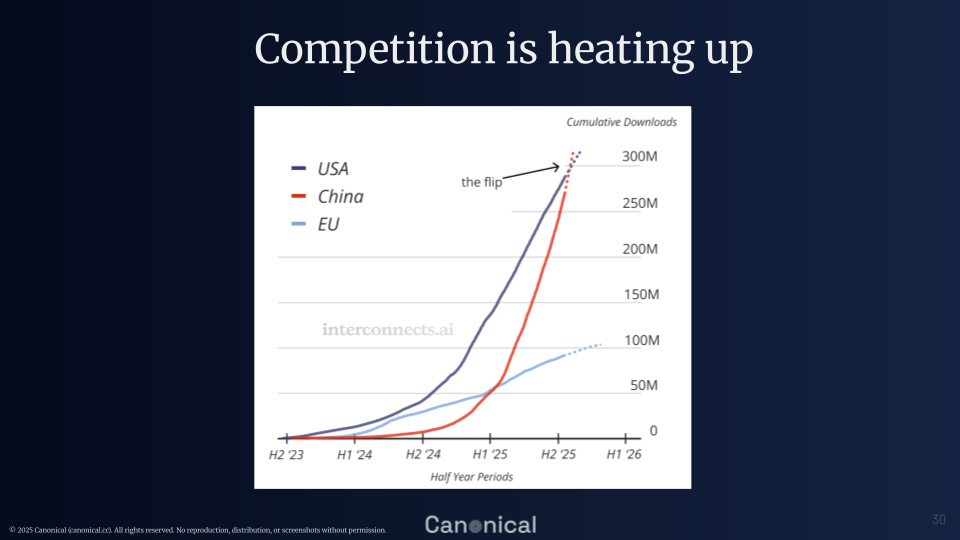
2. Competition in AI is heating up globally. Open-source models are surging, particularly from China, and could even surpass U.S. models. But the incentive structure for open-source AI is broken. As competition intensifies, crypto offers the missing economic foundation for truly open AI to thrive and surpass proprietary approaches.
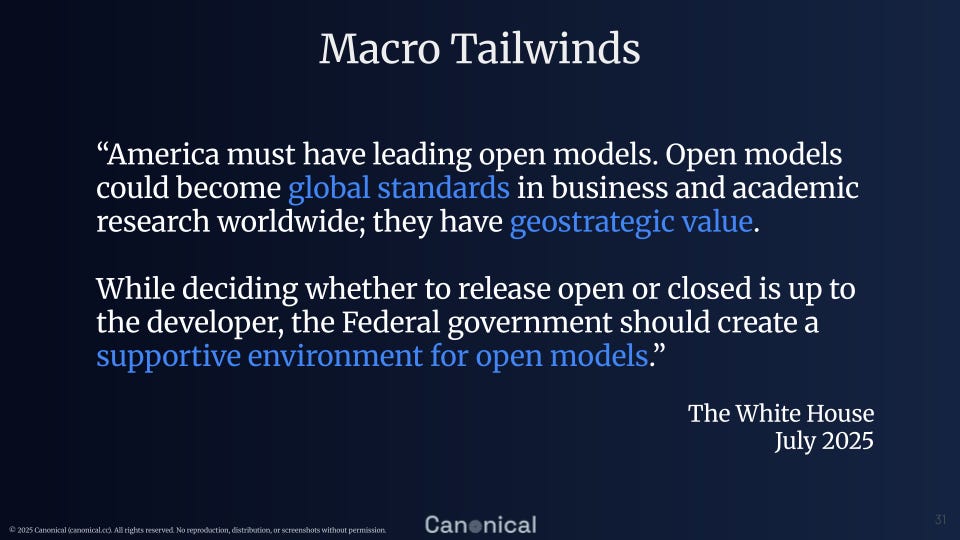
3. The macro and policy tailwinds. Even the White House has recognized the importance of open models, and it’s becoming a strategic focus. We anticipate a wave of open models being built here in the U.S., and that blockchains will be used to maximize their impact. The key is that the environment is ripe and we’re acting with a sense of urgency.
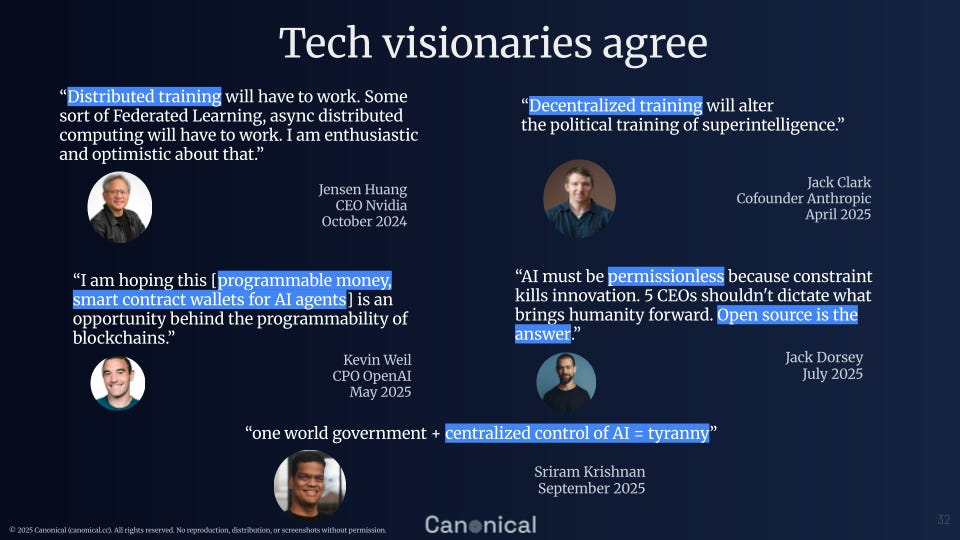
4. No longer fringe. Decentralized AI is quickly becoming consensus among tech leaders, including Jensen Huang (Nvidia), Jack Clark (Anthropic), Kevin Weil (OpenAI), Jack Dorsey, and Sriram Krishnan.
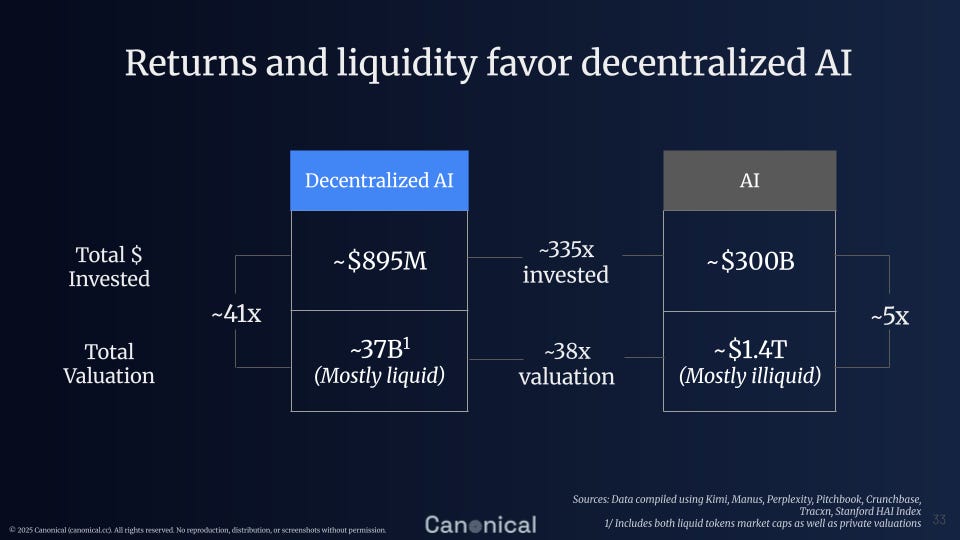
5. Returns and liquidity favor decentralized AI. Between January 2023 and March 2025, Decentralized AI projects received approximately $900M in funding and are collectively worth around $37B (both liquid and illiquid projects): a 41x multiple on invested capital in just over two years. During the same period, $300B was invested in centralized AI projects, now worth $1.4T, a 5x multiple (mostly illiquid).
This proves:
Decentralized AI projects received disproportionately lower funding.
But these projects have realized outsized multiples in a condensed time frame.
Crypto is an equitable system for generating and creating value.
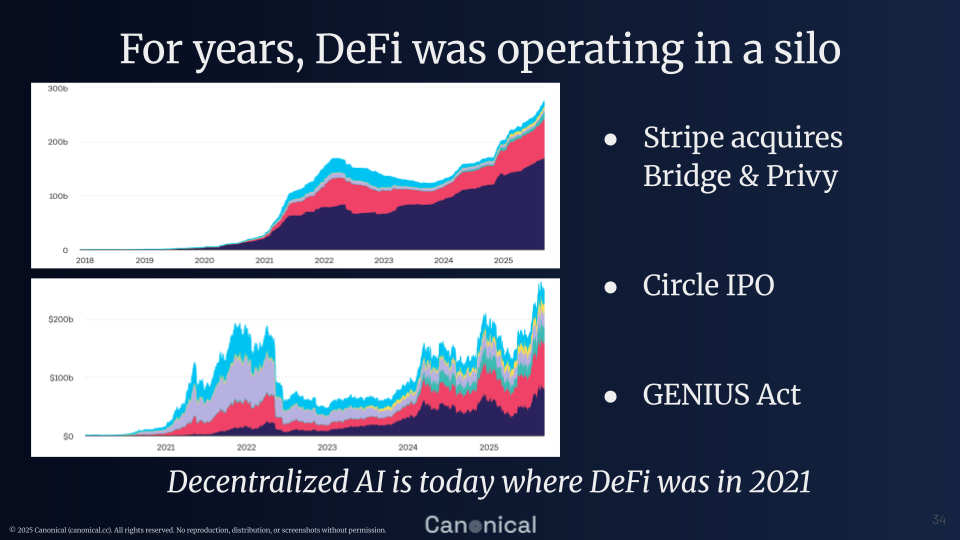
To draw a parallel with DeFi, for years, DeFi grew in a silo, and we weren’t sure how it would plug into the broader economy. It wasn’t until moves like Stripe acquiring Bridge & Privy or Circle moving toward an IPO that people realized the potential of what had been built.
We see Decentralized AI at a similar point to DeFi in 2021: the infrastructure and ideas are there, and the major real-world tie-ins are just beginning to emerge. And as we saw, once DeFi products proved superior (DEXs catching up to CEXs), adoption exploded. We believe decentralized AI is on the cusp of a similar breakout.
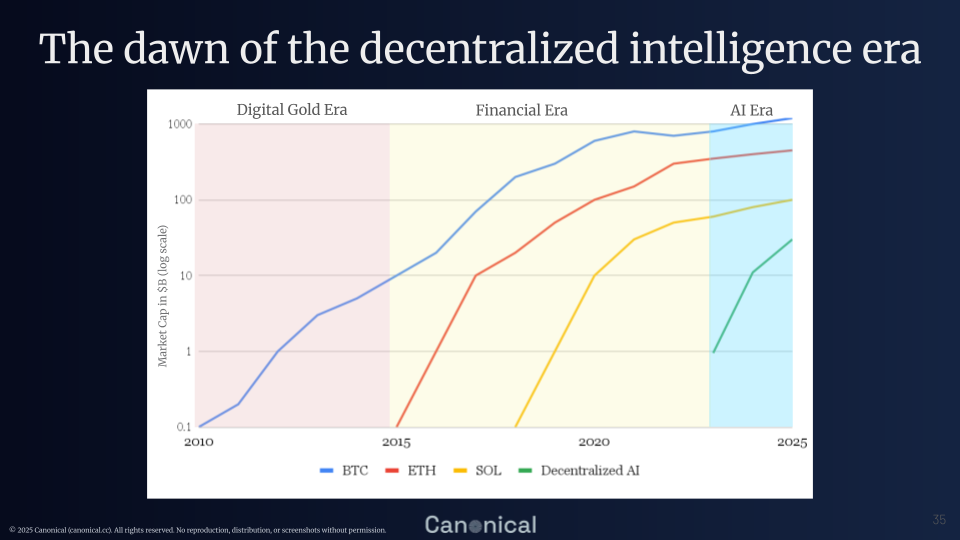
Below, you’ll see our final chart, which puts decentralized AI in context with the major crypto eras.
Bitcoin marked the beginning of the Digital Gold Era. From essentially zero in 2010, it took about five years to cross $10B, and just over a decade surpass $1T. That was the proof point for decentralized store-of-value.
Ethereum defined the Financial Era. Launched in 2015, it reached $100B in about six years, driven by DeFi, stablecoins, and programmability. That was escape velocity for programmable money.
Solana and new performant chains reached tens of billions in roughly three years, about half the time it took Ethereum, proving how quickly networks can scale once the infrastructure is in place.
Now we’re entering the AI Era. Decentralized AI is still in its early stages, barely a blip on this chart.
However, history shows that once product–market fit is achieved, market caps don’t move linearly. They accelerate. Bitcoin took nearly a decade to hit escape velocity, Ethereum six years, and Solana about three. Each wave compressed the time to scale by roughly half.
That’s why we believe decentralized AI will follow a similar trajectory, albeit even faster. With the potential to compound into a trillion-dollar category. We are still early, but not too early.
AI is inevitable. The question is whether its power will remain centralized in the hands of a few or whether we will build systems that are open, resilient, and community-owned.
At Canonical, we believe decentralized AI is the only path to sovereign intelligence. Crypto gave the world digital gold and programmable money. Now, it will give us open, verifiable intelligence, the foundation for the next trillion-dollar category.