
This week I was at 3 events in SF where the discussion centered on whether we’re in the GPT-2 or GPT-3 era in robotics. I think that’s the wrong question.
The underlying assumption here is that progress in robotics is predicated on step-function model breakthroughs. But models and task reliability are already improving consistently and scaling behavior looks real - this isn’t the bottleneck!
The real bottleneck is economics - we need cheap, globally scalable robots that can be put in a warehouse, hospital, or field and drive top-line improvements or efficiency gains. Robotics doesn’t need a GPT-3 moment. It needs a Model T moment.
Cost is the entry point
Cheap robots help make robotic deployments economically feasible and accessible. Robotic deployments create data, data improves autonomy, and autonomy lowers cost and increases value. We think this loop is the most important one in robotics.
This flies in the face of traditional hardware economics, where companies treat cost as something to address only at scale. History teaches us to first build the most capable version, sell it at the top of the market, and use that to subsidize the ramp, driving BOM cost down later with economies of scale.
Unfortunately, that doesn’t work in robotics, because you need deployments to generate the data that improves autonomy, and you need better autonomy to increase value-per-robot and robot-per-teleoperator ratio.
In other words, a robot that starts expensive never gets enough deployments to become cheap. It gets stuck at the top of the loop.
Robo
Today, our portfolio company Robo comes out of stealth. Robo builds affordable, general-purpose robots and teleoperation infrastructure.
Their first robot is Robo-T. Designed and built here in Los Angeles, it holds 10 pounds and runs tasks across warehouses, hospitals, food manufacturing, and logistics environments.
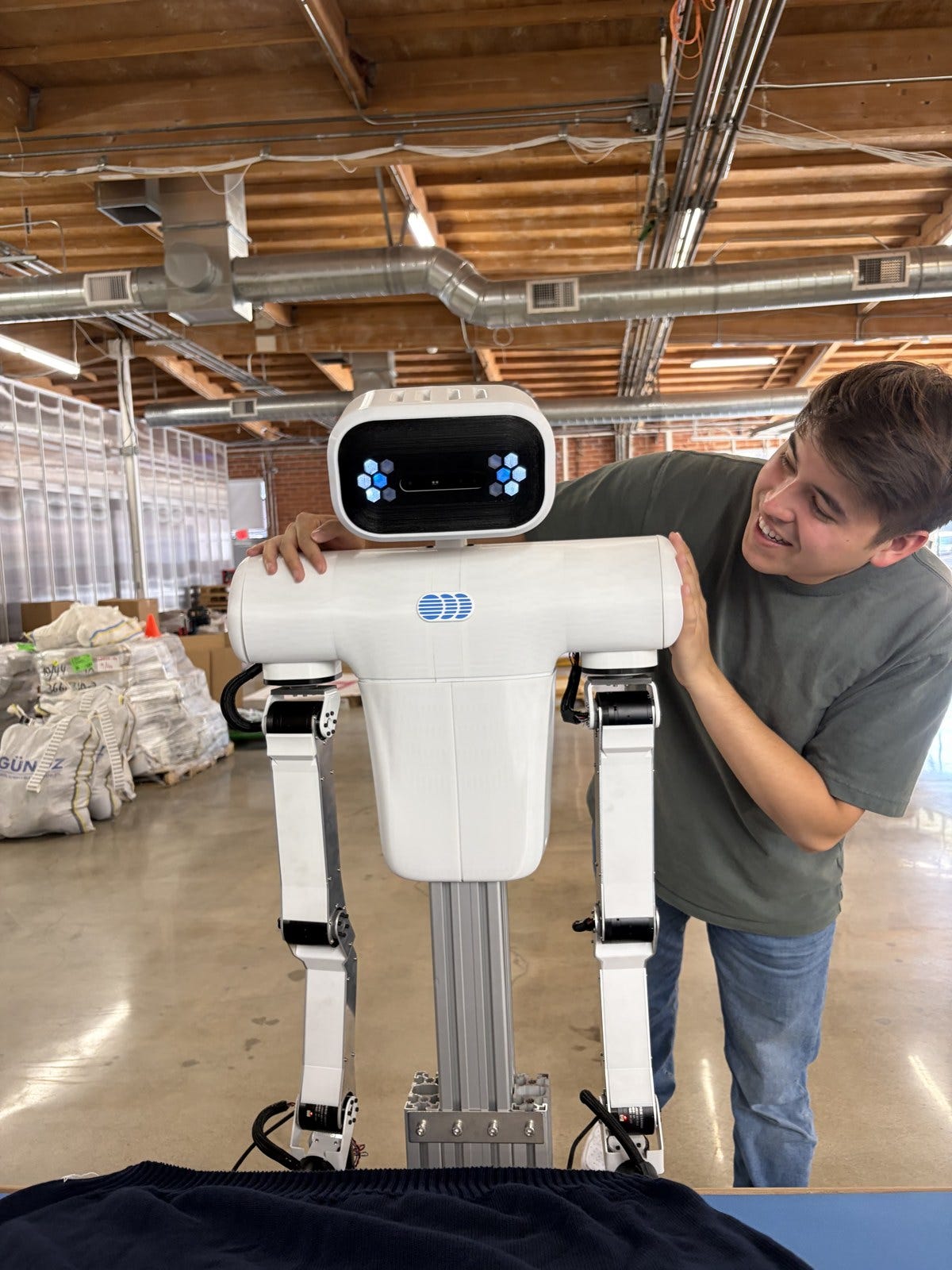
Over the past three months I’ve seen Robo go from robotic-effectors to robot arms to a full mobile embodiment, and relentlessly cut deployment costs by owning the full stack to just $10/hour. They also built Roboport, their own teleoperation platform, rather than renting one. It turns demonstrations, rollouts, and interventions into improving autonomy, helping close the cost-autonomy loop.
Robo’s founders, Don and Kyle, are high-integrity, high-velocity builders with a rare blend of technical depth, product intuition, and customer obsession. They pivoted into robotics midway through our diligence, and seeing their speed and pragmatism helped get us over the line at pre-seed.
Robo is now looking for fleet partners. Similar to operators of Tesla fleets for Uber or Lyft - Robo are looking for people who buy 15+ Robo-Ts, deployed around the clock, and sell the hours. Those fleets ended up providing much of the liquidity on Uber’s supply side, and turned out to be very good businesses for the people running them. Robo handles delivery, setup, and maintenance; what you need is organization and the communication skills to teach operators a task.
If you’re building here, or want to run a fleet, reach out to them directly. And if you’re working on anything at the intersection of cheap embodiment and real deployment, come talk to us at Canonical.